

REVISIT: Why We Lose Young Men
Understanding the insecurity pipeline from the manosphere to the ballot box
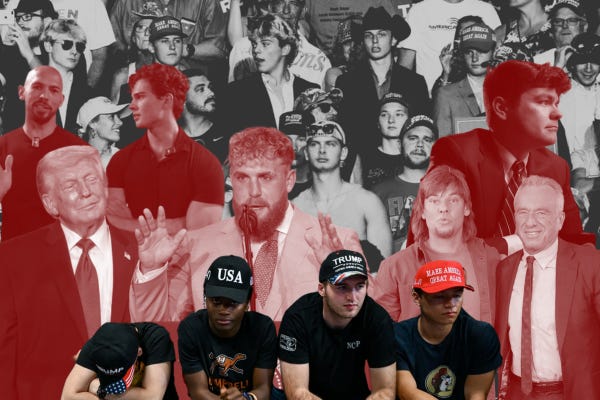
Everyone in politics is asking the same question right now: why are Democrats losing young men? More specifically, why are so many young men gravitating toward what people call the “manosphere”—the online ecosystem of influencers, podcasts, and personalities built around hyper-masculine identity, grievance politics, and reactionary culture.
A lot of people try to explain this through economics. They say young men feel left behind financially, that wages are stagnant, that housing is unaffordable, and that stable careers are harder to find. All of that is true. But I think the deeper issue is something more psychological. It is about the perceived opportunity to be successful in this country: successful financially, successful as someone who can take care of a family, and successful in terms of status and identity—strong instead of weak, respected instead of emasculated.
At its core, this whole dynamic is about belonging to the pack. The manosphere has become very good at reinforcing that pack mentality, tapping directly into one of the most primal fears young men have: the fear that if you fall behind, you will be left behind. Thrown out in the cold. Left out of the tribe.
For years Democrats have talked about leveling the playing field and expanding rights. Those are good goals and necessary ones. But while we were doing that, the Right—and an entire ecosystem of influencers—were telling young men a very different story. They told them something simple: that they are losing something before they ever even had the chance to have it. When you frame the world that way, it feels deeply unfair. The story these men hear over and over again is that society is designed to make sure they never succeed, and worse, that they will be left behind.
The Theology of Dominance
One of the ways these insecurities get reinforced is through religion. Over the past several decades, a particular strain of Christianity has become very influential in American politics, especially through the rise of the Evangelical Right, Christian Nationalism, and the Prosperity Gospel. Figures like Jerry Falwell and Pat Robertson helped popularize a worldview where masculinity is not simply natural but divinely ordained dominance.
Men are told they are supposed to lead, supposed to dominate, supposed to control. If that hierarchy is challenged, it is framed not merely as social change but as an attack on God’s design. And once you frame it that way, it becomes extremely difficult to argue against. After all, how do you argue with God?
This is not the same set of Christian values emphasized in many other traditions. In Catholic, Methodist, and Episcopal communities, the emphasis is often placed on service, humility, and dignity for all people. But the version amplified in political media often sounds very different: God blessed me by letting me be born in the United States, and I have the freedom to do whatever I can to make it. Success becomes proof of righteousness. Power becomes proof of virtue. Hierarchy becomes holy.
The Fear of Replacement
Most of these men do not hate women. Many of them want the same things previous generations of men wanted: relationships, families, stability, and the sense that hard work will lead somewhere. But they are also being told that as women gain opportunities and advance professionally, their own chances at achieving those same dreams are shrinking. They fear they will be forced to step aside. They fear they will be replaced.
For decades, young men were raised with a fairly clear expectation of adulthood: work hard, earn a decent wage, support a family, and society will recognize your role as a provider. But the economic system that supported that model has been eroding for years. Wages have stagnated, housing costs have exploded, and stable careers are harder to find. The path to adulthood now feels far less certain than it did for their parents.
Into that uncertainty, right-wing media offers a very convenient explanation. You are not struggling because the system changed. You are struggling because someone else took your place.
Take the panic around the term DEI. Why does it scare so many men? Because they are told that DEI is not about expanding opportunity but about demoting them. The argument they hear constantly is simple: those opportunities have to come from somewhere, so they must be taken from you. In that narrative, every promotion given to a woman becomes proof that men are being pushed out, every scholarship aimed at historically excluded communities becomes evidence that the system is rigged, and every diversity initiative becomes another symbol of their supposed decline.
Emotionally, that translates into something very tangible: less money, less opportunity, less respect, and less likelihood of building a stable life. Perhaps most powerful of all is the fear of looking like a failure. For generations, masculinity has been tied to the ability to provide. When that role feels threatened, the fear becomes existential. If they cannot fulfill the version of manhood they were raised to expect, then who exactly are they supposed to be?
The Right does not try to resolve that anxiety. It weaponizes it. Young men are told something simple: you did not fall behind, you were pushed, and someone else took what should have been yours.
The Scarcity Mindset
The same psychological dynamic appears in immigration debates. If you asked most of these young men for a detailed policy solution to immigration, they probably would not have one. They are not thinking about visa systems, asylum law, or labor markets. What they are reacting to is something much older: the belief that someone unknown is coming to take what belongs to them.
Whenever people believe resources are limited, the instinct to guard what you have becomes powerful. Immigration is often framed through that lens. The emotional reaction is not really about the jobs immigrants take, but about what those jobs represent.
Their own families may have taken those same jobs generations ago, but history rarely feels relevant in moments of insecurity. What matters is perception. And the emotional logic becomes very simple: so what? It is mine now. If someone else gets it, that means I lost.
That kind of thinking turns opportunity into a zero-sum game. If someone else rises, it must mean you are falling. The Right has spent years reinforcing that narrative. Immigration becomes not a complex policy issue but a direct threat to personal stability and identity.
Masculinity and the Culture War
The same insecurity helps explain the intensity of today’s culture wars. Why do some men react so strongly to being called “gay” or “weak”? Why does the existence of trans people provoke such visceral reactions from people who insist it has nothing to do with them?
For many of these men, the answer comes down to hierarchy. They were raised with a model of masculinity that works like a ranking system. At the top sits the ideal man: strong, successful, emotionally unshakeable, and clearly in control. Everything else sits somewhere below that standard.
When cultural norms shift and those boundaries blur, it can feel like the structure itself is under attack. Being called weak is not simply an insult; it is an accusation that someone has fallen down the social ladder. Once someone believes their identity is under threat, the conversation stops being about policy or social norms and becomes about survival.
The Influencer Pipeline
This is where the internet becomes incredibly powerful. When young boys say something ignorant or make a bad joke—as kids often do—the reaction they receive can shape how they interpret the culture around them. Sometimes that reaction is constructive. But online, it is often immediate condemnation.
For a teenager trying to figure out where he fits in the world, that can feel less like correction and more like rejection. That moment of friction is exactly where the influencer pipeline begins. Right-wing content creators are extremely good at identifying that feeling and exploiting it. They step in and say: they hate you, but we don’t.
Suddenly someone who felt embarrassed or rejected finds an entire online culture celebrating the exact behavior he was criticized for. What was once criticism becomes validation. What was once embarrassment becomes identity.
Over time, podcasts, livestreams, and social media personalities build an ecosystem where exaggerated masculinity becomes entertainment. At first it is framed as comedy—just jokes, just guys being guys. But gradually humor turns into grievance, grievance turns into ideology, and the algorithm rewards whoever pushes the boundary further.
Eventually defensiveness hardens into identity.
The Political Validation
Eventually those cultural frustrations move into politics. That is where someone like Donald Trump enters the picture. For many young men already immersed in this ecosystem, Trump does not just look like a political candidate. He looks like validation.
He says the same things they have been hearing for years: that elites are mocking them, immigrants are taking their jobs, the system is rigged, and masculinity is under attack. The message resonates not because it is sophisticated but because it feels familiar.
Trump reinforces the deeper worldview at the center of the movement: that life is a competition between winners and losers. Strength is everything. Weakness deserves ridicule. Success is not something shared; it is something conquered.
Supporting him becomes less about policy and more about recognition. He speaks their language. He validates their frustration. He gives their insecurity a political home.
Where We Went Wrong
So where did we go wrong? The answer is complicated. Many of the social changes that expanded opportunity were necessary and long overdue. But somewhere along the line, our cultural conversation about masculinity shifted in a way that many young men interpreted as rejection rather than reform.
Instead of saying masculinity should evolve, the conversation sometimes sounded like masculinity itself was the problem. The difference between toxic masculinity and masculinity itself became blurred. What many young men heard was not “be better,” but “be less”—less aggressive, less competitive, less masculine.
When identity feels attacked, people rarely respond by embracing criticism. They search for spaces where that identity is validated. The Right stepped into that vacuum.
A Better Way Forward
Recognizing this dynamic does not mean abandoning progress. Equality is not the problem. Justice is not the problem. But messaging matters.
If the goal is to build a healthier society, we need to offer young men a vision of masculinity that includes dignity and purpose. Positive masculinity does not mean returning to rigid gender hierarchies. It means redefining strength in ways that include responsibility, empathy, and respect.
Young men should be told it is okay to work hard, to be ambitious, and to take pride in providing for the people they love. But success does not diminish when others succeed alongside them. Protecting the women you love does not mean controlling them. It means defending their right to make their own choices.
The deeper message young men need to hear is surprisingly simple: it is okay to be a man. No one is trying to erase masculinity. Strength, empathy, responsibility, and respect are not contradictions. They are the foundations of a healthy society.
Because when success is no longer treated as a zero-sum game—when people believe opportunity can expand rather than simply shift—the fear that drives so much resentment begins to lose its power.
And when that fear fades, the politics built on it begin to lose their grip as well.
TL;DR
Young men didn’t suddenly become reactionary. They were recruited. The manosphere, conservative media, and right-wing politics built a pipeline that takes insecurity about status, identity, and success and turns it into resentment. Democrats expanded rights and opportunity—but often failed to explain how young men still fit into that future. Until we offer a version of masculinity that includes strength, dignity, and purpose without domination, that pipeline will keep filling.
Okay, and then, how do we fix this? Turning off the Internet isn’t all that practical.
Toxic shaming gets done on all sides