

Democratic Converts
No, Being Anti-Trump Is Not Enough to Be in Leadership

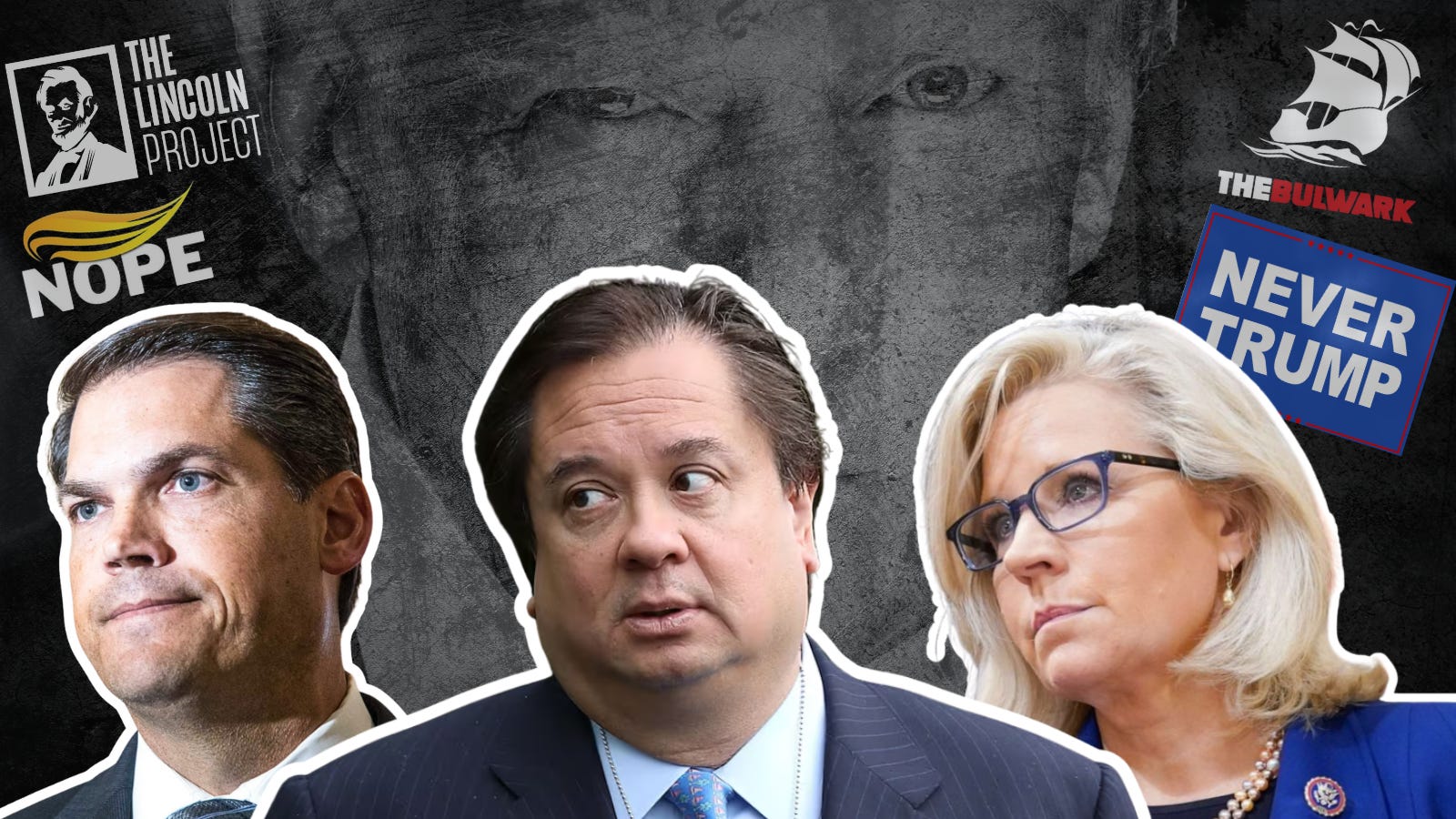
On January 6th of this year, I was scrolling through social media expecting the usual statements commemorating the 2021 insurrection—the recycled discourse about violent protest versus peaceful demonstration, the performative condemnations, the same old scripts. But almost immediately, an announcement cut through the noise: former Republican operative George Conway was announcing his candidacy for New York’s 12th Congressional District… as a Democrat.
For the uninitiated, George Conway made his name in the 1990s as a Republican political operative. He helped funnel salacious material from Linda Tripp and other accusers to Ann Coulter and Matt Drudge to publicly smear President Bill Clinton during the Lewinsky scandal. He represented Paula Jones in her lawsuit against Clinton, which led to Clinton’s deposition—where Clinton denied the affair with Monica Lewinsky—setting off the chain of events that culminated in impeachment.
Whatever one thinks about Clinton’s guilt or innocence, one thing is undeniable: Conway was a Republican operative through and through. He married Kellyanne Conway, a major Republican pollster and strategist. They lived together in Trump Tower. Kellyanne went on to become Donald Trump’s campaign adviser and White House press secretary while they were still married. George himself was even floated as a potential Solicitor General in a Trump administration. These were not passive participants. These were people who believed in Donald Trump—or at least in the machinery that elevated him—and helped usher him into power.
Eventually, in 2018, Conway publicly broke with Trump and helped found the Lincoln Project—more on that later. And yes, anti-Trump advocacy from figures like Conway was helpful in defeating Trump and electing Joe Biden two years later. But that still leaves an uncomfortable, unanswered question: had Donald Trump never been elected, would George Conway—and others like him—still be Republicans today?
It’s a sliding-doors question, but it matters. If your sole justification for joining the Democratic Party—or running as a Democrat after a career as a GOP operative—is opposition to Trump, what happens when Trump is no longer on the ballot? Do you actually believe in the principles of the party you now want to represent, or do you quietly drift back to the GOP once the emergency has passed?
And don’t get me wrong: building a coalition broad enough to win elections means welcoming former conservatives and Republicans who are willing to break ranks. That’s good politics. But that does not mean those individuals should be vaulted to the front of the line—elevated as party leaders or standard-bearers—simply because they exercised basic moral clarity at a late stage.
This is a tension Democrats have struggled with throughout the Trump era. And it raises a deeper question: what message does it send to the party’s most loyal members when the people we elevate fastest are the same people we were fighting just a few years ago?
Not Until It Happens To You
What makes this dynamic especially frustrating is that many of these former Republicans were either complacent with their party’s behavior for years—or actively benefited from it. It wasn’t until something happened to them, or to people they directly identified with, that the line was finally crossed.
Take former Congresswoman Liz Cheney. Her career—and her political standing—were built on the legacy of her father, Dick Cheney, and on her enthusiastic embrace of the GOP’s most regressive policies. At one point, she even publicly attacked her own sister for being gay to advance her career in Republican politics.
And yet it took a full-blown insurrection and an attack on the Capitol for her to finally say “enough.” Everything prior to January 6, 2021, was apparently acceptable. She often voted with Trump, defended his agenda, and only broke when the violence became undeniable and politically untenable.
So what did Democrats do in response? We bent over backwards to place her front and center—rolling her out as a surrogate for Democratic candidates in swing states, even alongside our own nominee in 2024.
That same pattern repeated itself at the 2024 Democratic National Convention. Former Republican members of Congress and ex-Trump staffers were given more speaking time than grassroots Democratic activists who had spent years—sometimes decades—doing the unglamorous work of organizing, mobilizing, and holding the party together. Some of these speakers had remained inside Trump’s White House until January 6th itself, yet they were celebrated for what many Democrats would consider basic common sense.
We saw a similar phenomenon among white women voters. In 2016, white women voted for Trump 47–45. In 2020, that margin widened to 55–44. It wasn’t until Roe v. Wade was overturned that many began to meaningfully break with the GOP. While self-interest is a powerful political motivator, the timeline matters. Many of these voters dismissed warnings for years—insisting critics were overreacting when they said a Trump-packed Supreme Court would overturn Roe—until it actually happened.
One individual seized that moment in 2022 and built a platform around it. Suzanne Lambert, a former Republican and aspiring comedian, leveraged her political “conversion” into a large online following and a new role as a Democratic influencer. Just a few years earlier, she was writing about how feminism and conservatism aligned and criticizing Jezebel. Suddenly, she was being welcomed into Democratic congressional offices and invited to create content at Democratic campaign events.
There are thousands of young Democrats who have spent years doing movement work who will never receive that level of access or amplification—not because they lack talent or commitment, but because they don’t come with the novelty of a dramatic political face‑turn. That reality is demoralizing for people who didn’t need a personal reckoning to recognize injustice, who didn’t wait until Roe fell to understand that bodily autonomy outweighed tax policy.
Lambert has responded dismissively to critics, telling them she’s “not running for Best Liberal” and that people should “leave their hall monitor behavior at the door.”
Look, I appreciate the no-f**ks-given attitude and not letting your opps get you down. As a wise philosopher once said, “Let your haters be your waiters as you sit down at the table of success.”
But the defensive reaction from many on the Left isn’t hard to understand. From their perspective, someone just showed up, immediately started telling them what to do, and was handed access they’ve spent years working toward.
Call it jealousy. Call it envy. But if we consistently reward those who once opposed the party while overlooking those who have always been here, what lesson are we teaching?
The Shoehorn
Too often, former Republicans mistake gratitude for admiration. They confuse appreciation for their defection with an endorsement of their leadership. And too often, Democrats reinforce that mistake.
We see it in George Conway’s congressional run. We see it in the DNC’s obsession with spotlighting former Republicans at marquee events. The underlying assumption is that because these individuals “know the other side,” they must be uniquely qualified to lead or speak for Democrats.
This logic powered the Lincoln Project’s entire grift: the idea that a vast, untapped bloc of moderate Republicans was just waiting to abandon Trump, and that only former GOP operatives could unlock them. Democratic donors bought in. The results never materialized. (Also shout Lincoln Project co-founder Steve Schmidt who blocked me on Twitter for calling out that making Liz Cheney Speaker in 2022 would be incredibly stupid.)
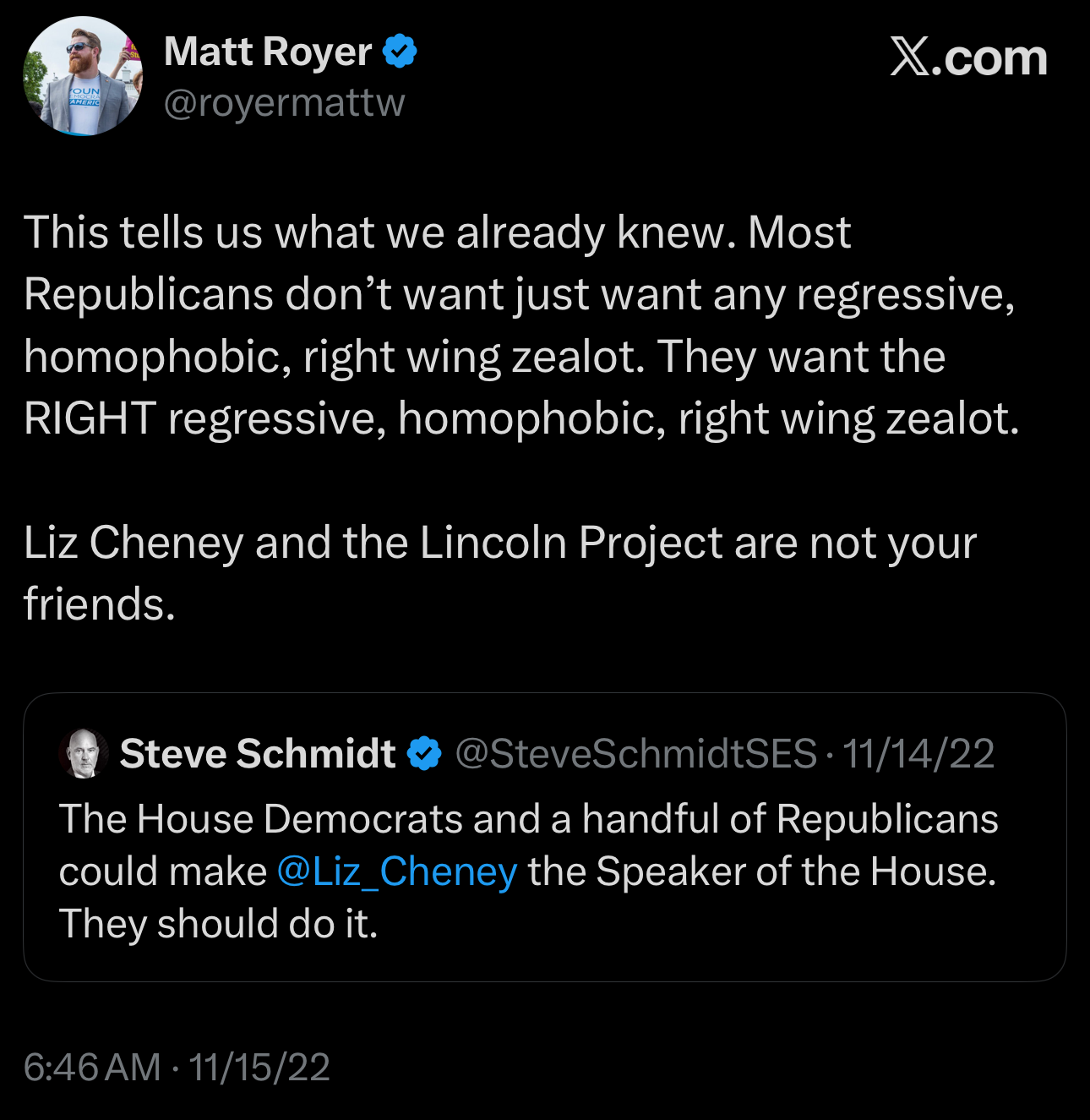
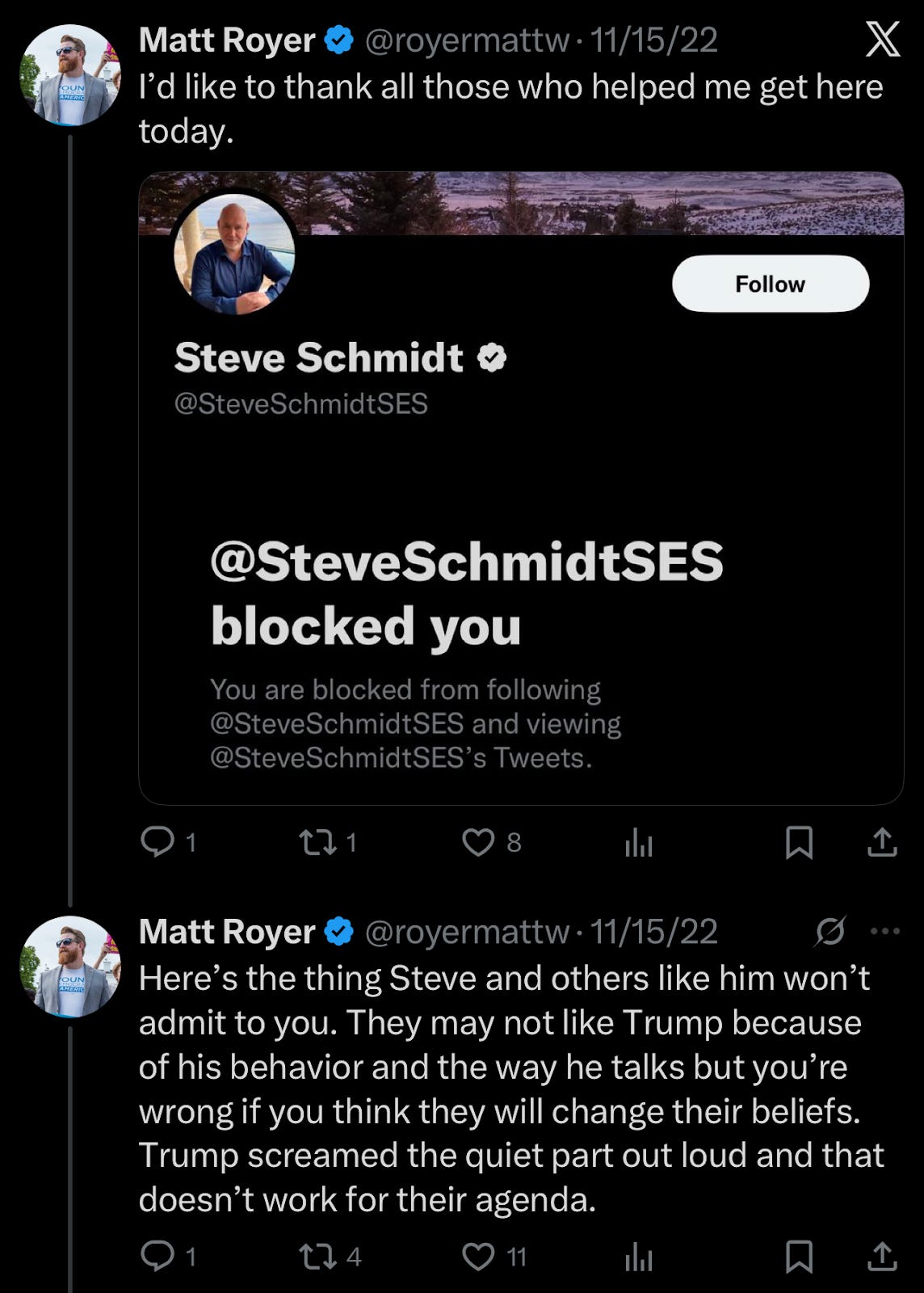
Many Lincoln Project founders have since reinvented themselves as pundits, freely offering advice about what Democrats should and shouldn’t do—often while collecting donations from Democrats desperate to believe that conservative‑lite messaging was the path to victory. That worldview has left Democrats endlessly chasing a mythical centrist Republican who, after three Trump elections across more than a decade, simply does not exist.
And Conway isn’t alone. Former Georgia lieutenant governor Geoff Duncan is now running for governor as a Democrat after breaking with Trump and supporting Kamala Harris in 2024—a move that led to his expulsion from the GOP. But in both cases, the core pitch is the same: opposition to Trump. Beyond a few buzzwords about affordability or healthcare, there’s little evidence of a substantive ideological shift.
One thing that has happened here in Virginia specifically is the Trump-era faceturns taken by some former Republican members of Congress and the General Assembly, and how they have become surrogates for our Democratic candidates to court the mythic “Republican swing voter.”. Some notable members of this class of Never Trumper Republicans are former Delegate David Ramadan, former Congressman Denver Riggleman, and former Congresswoman Barbara Comstock, all of whom stumped for Democrats on the campaign trail in 2024 and 2025.
However, they seem to forget how they created a name for themselves, which was on stepping on the necks of the same people they are courting and with policies we are actively working against. Congresswoman Comstock, for instance, worked hard to try to repeal the Affordable Care Act while she was in Congress, and before that, worked hard against Virginia’s labor force in the General Assembly, supporting Right to Work Legislation and the legislation that eliminated Project Labor Agreements (PLAs) for Phase 2 of the Metro Silver Line, which created massive delays in construction as well as many safety and maintenance concerns, estimated to end up costing the taxpayer millions more than she claimed hiring union labor would.
Opposing Trump is necessary. It’s just not sufficient.
Extremely Superficial
Voters want leaders with substance—people who have a reason to be here beyond occupying a role or playing a part. Some political converts struggle with that. They often perform what they think liberalism looks like rather than grounding their politics in a coherent set of values.
Like recent TradCath converts, these new Democrats can be hyper‑performative and overzealous, compensating for shallow roots with aggressive certainty. They police tone, lecture longtime activists, and hedge on policies that should be non‑negotiable—revealing a lack of loyalty when things get uncomfortable.
Virginia Democrats saw this dynamic play out during last year’s Attorney General race. When controversy emerged around now‑Attorney General Jay Jones, Democrats wrestled with it internally. Many condemned the behavior, recalibrated, and kept working.
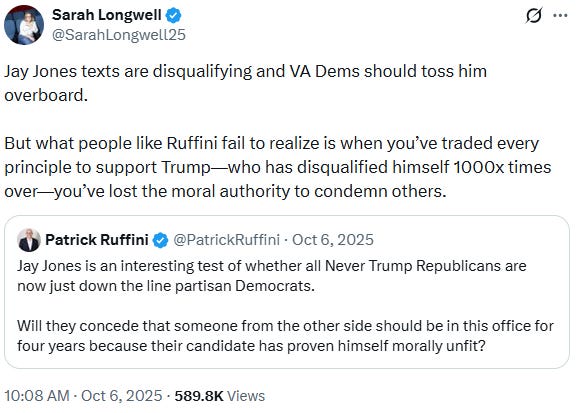
After Politico broke the story on the Young Republican “I Love Hitler” group texts, the Republicans found it an easy target to go after Jones and his text messages. But instead of letting it lie, Tim Miller and Sarah Longwell decided to kick it up a notch by saying things like “Jay Jones sucks” and going as far as to tell Virginia Democrats that they should force Jones to drop out of the race or resign the Attorney General office if he won.
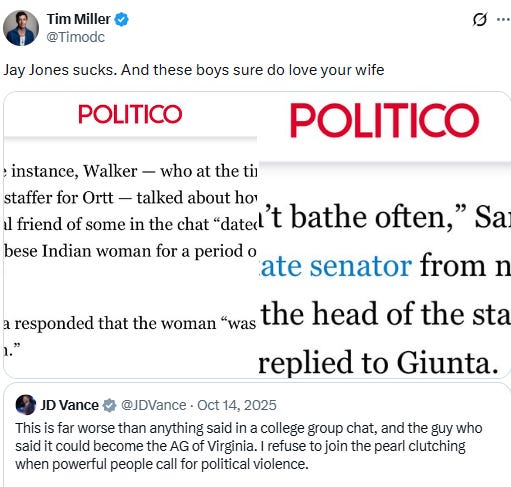
As Ta‑Nehisi Coates once asked: was silence not an option?
For Virginia Democrats, this kind of condemnation was not helpful. We had a candidate that we had to support, and as soon as there was a bump in the road, these Never Trumpers, who previously had supported and worked for the likes of Jeb Bush and the Log Cabin Republicans, wanted to throw him overboard. That left a bad taste in many Democrats’ mouths and showed a lack of real loyalty to the Party.
The Bulwark offers a more rational conservative viewpoint on many issues and helps outlets like Crooked Media appear more bipartisan, while reaching a new audience. I get that. But it doesn’t mean they necessarily know what’s best for the Democratic Party. So when these folks are pushing candidates like George Conway to be the face of the Democratic Party, we should always be wary of that.
For Virginia Democrats, that kind of intervention wasn’t helpful—it was revealing. At the first sign of turbulence, people who had once supported Jeb Bush and worked comfortably within Republican power structures were eager to throw a Democratic candidate overboard. That lack of loyalty left a sour taste.
There is value in engaging audiences across ideological lines. But that does not mean these voices know what’s best for the Democratic Party—or that they should decide who leads it.
The Bottom Line
After more than a decade of Donald Trump dominating American politics, Democrats—especially older liberals and institutional leaders—need to confront a hard truth: the Democratic Party is not merely a reactive vehicle designed to oppose one man. We are not a temporary coalition formed in response to a singular threat. We are a party with a governing philosophy, a moral framework, and a responsibility to deliver material change to people’s lives.
Trumpism exposed the rot inside the Republican Party, but it did not create it. Many of the policies Democrats fight against today—attacks on labor, reproductive freedom, voting rights, civil rights, and economic regulation—were championed long before Trump descended the escalator. If someone’s political awakening begins and ends with Trump, that should invite scrutiny, not automatic elevation.
Yes, we should welcome people who leave the GOP. Yes, building a winning coalition requires persuasion, grace, and room for growth. But welcoming someone into the coalition is not the same thing as handing them the microphone, the strategy memo, or the leadership mantle on day one. Trust, credibility, and leadership are earned through consistency, not proximity to power or novelty.
It is not enough to be anti-Trump. It is not enough to repeat liberal buzzwords, invoke the right villains, or mimic the aesthetic of Democratic politics. Opposition alone is not a platform. A handful of well-tested talking points does not equal a worldview. And parroting what Democrats want to hear is not the same as standing with Democrats when it is inconvenient, unpopular, or costly.
Meanwhile, there are thousands of Democrats—especially young Democrats—who have spent years organizing, losing races, rebuilding infrastructure, and staying engaged when it wasn’t politically fashionable or personally advantageous. They worked through cycles of disappointment, internal conflict, and thin resources. They believed in the party’s values before it was trending to do so. These are the people who understand the movement not as a brand, but as a commitment.
If Democrats continue to prioritize converts over the faithful, novelty over loyalty, and media-friendly defectors over movement builders, we risk hollowing out our own bench. We risk teaching the next generation that the fastest path to influence is not dedication or organizing, but rebranding.
We should celebrate genuine growth. We should acknowledge courage when people break from destructive ideologies. But celebration is not the same as deference. And gratitude is not a governing strategy.
The future of the Democratic Party depends on who we choose to elevate—and why. If we want a party that lasts beyond Trump, we need leaders who believe in something more enduring than opposition to him.
TL;DR: The Problem with Democratic Converts
✅ The Problem: Being anti-Trump is a baseline for moral clarity, not a qualification for leadership. Too often, the Democratic “old guard” vaults former Republican operatives to the front of the line simply because they had a late-stage epiphany, overlooking the “faithful” who have done the unglamorous work for decades.
✅ Novelty vs. Consistency: We are teaching the next generation that the fastest path to influence isn’t organizing—it’s rebranding. Figures like George Conway or Liz Cheney are celebrated for “basic common sense” while grassroots activists are sidelined for the “novelty of a dramatic political face-turn”.
✅ Substance Over “Vibes”: Many of these “converts” haven’t actually shifted their ideology. For example, former Congresswoman Barbara Comstock stumped for Democrats despite a career spent trying to repeal the Affordable Care Act and attacking Virginia’s labor force. Opposing one man is not a governing philosophy.
✅ The Loyalty Gap: These newcomers are often “hyper-performative” but show a distinct lack of loyalty when things get uncomfortable. We saw this when Never-Trumpers like Sarah Longwell and Tim Miller were eager to “throw Jay Jones overboard” at the first sign of a campaign bump, revealing they don’t actually know—or care—what’s best for the party’s long-term success.
🏛 Bottom line: The Democratic Party is not a temporary reactive vehicle; it is a party with a moral framework and a responsibility to deliver material change. Trust, credibility, and leadership must be earned through consistency, not proximity to power or a sudden change in “aesthetic”. We need leaders who believe in something more enduring than just being against Donald Trump.
I have consistently concluded the same concerns. We must be diligent after Trump/MAGA is defeated. We do not need a bunch of new neoliberals running the Democratic Party. The old ones are bad enough! We have to unite with all anti-Trump/Maga folks to regain what is left of our democratic processes. When we rebuild our constitutional government we need honest liberals and progressives like AOC and Bernie, Jamie Raskin, etc, If you haven’t noticed the majority of commentators now on MS Now are former Republicans, who prior to Trump/MAGA were pushing corporate tax cuts and fighting against unions and healthcare for all, anti -women’s rights to control their bodies, cuts to social security, Medicare and Medicaid as well as SNAP benefits for hungry kids. Clinton pushing NAFTA through and ending restrictions on consumer banks are just two examples of corporate democrats hurting the working class for corporate money and support. We must say NEVER AGAIN will we let the majority of our population suffer to benefit the very wealthy!!! No more wolfs in Democrat disguises, taking millions from AIPAC and other conservative money laundering PACs.
Yes, and. The Democratic party has a serious bunch of dinosaurs making policy, making rules, and leading us over the cliff ("Thou Shalt Not Primary the Dinosaurs," "Thou Shalt Not Contract With Those Who Primary the Dinosaurs," "It is better to be silent than be a target," "Nametag defillade is safe for me, sorry for you," and "That's the Way We've Always Done It" to name a few...) and ignoring newer, younger, fresher voices and ideas that speak for and to the younger voters we need, and those of us who hate losing (I'm 70, white, male, veteran, and I HATE the losing!). Loyalty, particularly in the service of past wins, past glory, will not cut it moving forward. trump has broken things so thoroughly, so completely, that going back is not possible. "Normal," meaning the way it was before it got broken, wasn't all that great for working people, the middle class, the environment, people of color, and on, and on. So, yeah, I say a big "Hell, No" to having the likes of George Conway or Liz Cheney or Steve Schmidt leading this party, but I'm going to echo that call if you ask me about Chuck Schumer, or the bunch that caved in in 2025, or the folks who look to be saying that the attacks on Iran "might" be okay. Quit ignoring people, voices like Zohran Mamdani, Alexandria Ocasio Cortes, Summer Lee, Maxwell Frost, Delia Ramirez, Analilia Mejia, Governor Wes Moore and Mayor Brandon Johnson, and even moderate voices like Elissa Slotkin, JB Pritzker and many others across the country, who aren't mired in the status quo of losing and not knowing why. In my opinion.