

DoubleSpeak to DoubleThink: The GOP’s Ever-Evolving Belief on Redistricting.
How the GOP talked itself into knots — and why Democrats have to finish what they started

I didn’t miss a week. What are you talking about?
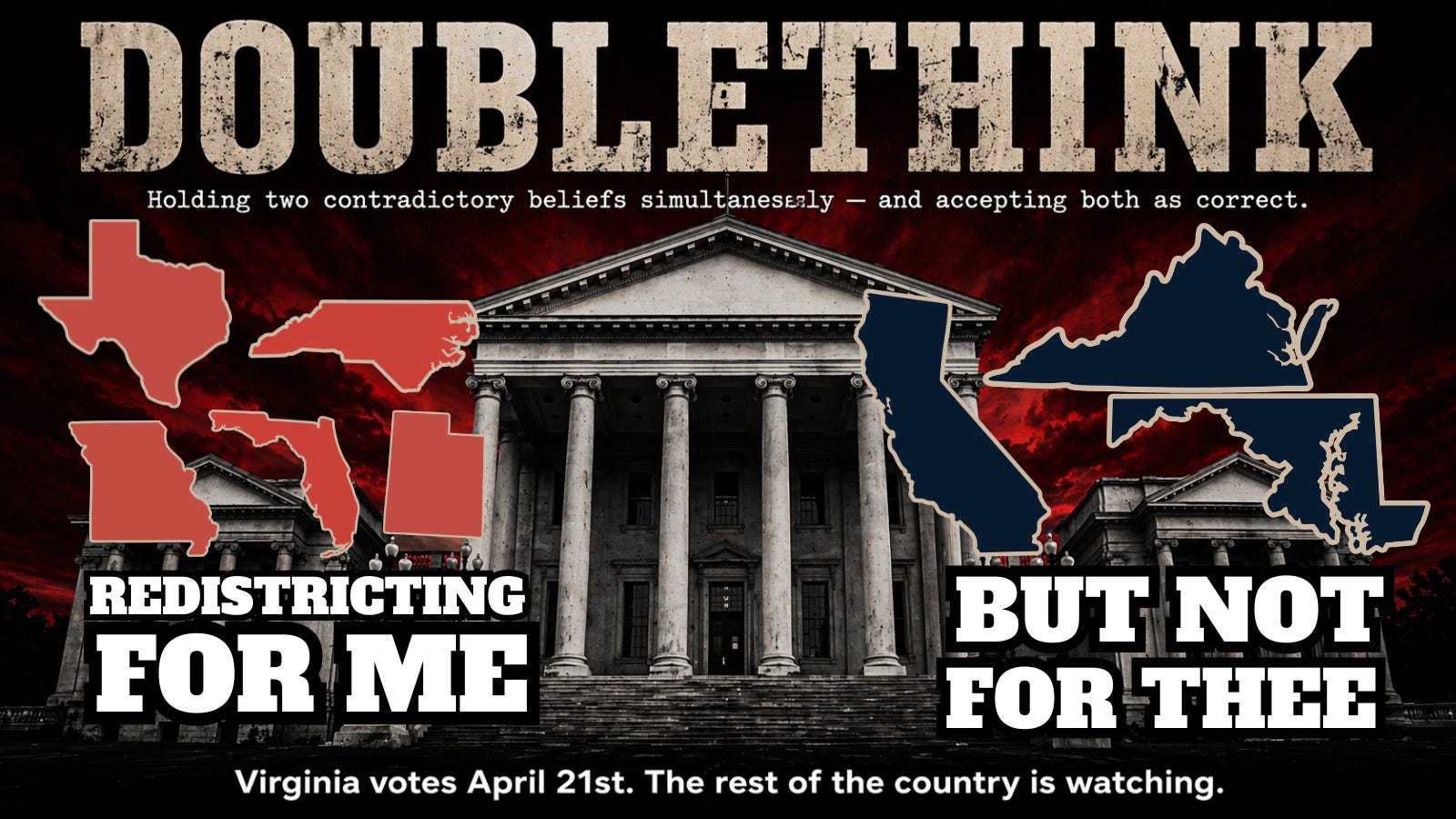
Unless you’ve been living under a rock, haven’t gotten the mail recently, or haven’t stopped at a gas pump lately, you may have missed that Virginia has a special election coming up on April 21st — a ballot referendum that could determine which party controls the House of Representatives after 2026. Online discourse has become a cesspool of hot takes and insults, traded between anonymous X accounts and sitting elected officials alike. Right-wingers cry foul. Democrats say “that’s just the way it has to be” when it comes to drawing new lines stretching from Arlington to Rockingham.
If you showed these posts to someone in 2019, they’d wonder what backward parallel universe you’d just come from. And then you’d just have to laugh to keep from crying and tell them to buckle up for the post-2020 world.
Because in today’s world, the most liberal states — California — are passing ballot referendums to allow for gerrymandering. Conservative states like Utah are defeating ballot initiatives to repeal anti-gerrymandering laws. Republican lawmakers in red states like Indiana are voting down their own party’s pro-gerrymandering legislation. Orwell would have notes.
Democrats celebrate the defeat of Republican gerrymanders in red states while campaigning to gerrymander blue ones. Republicans stand up PACs with words like “justice” and “democracy” in their names, then exploit the language of marginalized communities of color in blue states to try to protect the same voters they work to marginalize in red ones.
It would be funny if it weren’t so nakedly cynical.
Now it’s not uncommon in Virginia to see former President Barack Obama staring back at you from your TV, your phone, or a gas pump, telling you to vote yes on the amendment. Governor Abigail Spanberger has been out in force making the same case. And yet — oddly enough — you’ll also find mailers and texts from a PAC with a rotating cast of patriotic-sounding names, telling you that Obama and Spanberger want you to vote against the amendment. They’re citing quotes from both politicians — taken from years ago, stripped of context, weaponized.
The PAC responsible for those mailers has a name: Justice for Democracy. Its chair is A.C. Cordoza, a former Republican delegate. It was created four days before the first mailers hit mailboxes. Its single largest reported contribution — $2.5 million — came from a dark money organization backed by Peter Thiel.
Read that again. A Peter Thiel-backed dark money group, operating through a PAC that didn’t exist a week earlier, chaired by a former Republican officeholder, is sending Virginia voters mailers featuring Barack Obama’s face to tell them that Obama opposes redistricting. Obama, who recorded a video ad urging Virginians to vote yes on the very amendment the mailer claims he opposes.
This is not a messaging dispute. This is manufactured confusion, funded by people who have a direct financial interest in keeping Democratic representation as weak as possible. The goal was never persuasion. It was fog.
Some of what’s detailed above — particularly the dark money trail behind Justice for Democracy — was first surfaced in reporting by the Virginia Mercury, to which I contributed sourcing and documentation. The receipts exist. They’re public. And they tell a story the No side is counting on you not to read.
Because apparently, a piece of paper is supposed to be more convincing than the actual words coming directly from the same person’s mouth.
That’s the point. Confusion is the strategy. The Right is counting on Virginians not to pay attention to what’s happening right in front of them. “America First” isolationism conveniently becomes “Virginia First” the moment the national context stops working in their favor.
They want you to believe they care about representation and fair elections. They want you to forget that Senator Mitch McConnell said, just a few years ago, that Election Day shouldn’t be a federal holiday because Republicans lose when more people vote. They want you to forget that this sentiment has roots going back decades — to Heritage Foundation and ALEC co-founder Paul Weyrich, who said plainly in 1980: “I don’t want everybody to vote. As a matter of fact, our leverage in the election quite candidly goes up as the voting populace goes down.”
Forty-five years later, that is still the operating theory. They just stopped saying it out loud.
They want you not to pay attention to Congress, where Senator Mike Lee and his Republican colleagues are ramming through the SAVE Act under the guise of “election integrity” — a solution in search of a problem that adds unnecessary restrictions to voting without answering the obvious question: if election fraud is so rampant, how did Donald Trump and Republicans win so handily in 2024?
And most importantly, they desperately want you to forget how this whole gerrymandering mess started in the first place.
In Orwell’s 1984, DoubleSpeak is language designed to obscure truth. DoubleThink is the ability to hold two contradictory beliefs simultaneously and accept both as correct. The Right has mastered both — and they have arrived at a place where they appear to genuinely believe what they’re selling. They simultaneously argue that redistricting is a necessary evil in red states because Democrats are obstructing in Congress, and that Democratic retributive redistricting is an evil that marginalizes Republicans. They hold both truths at once without blinking.
That’s a dangerous place to be, especially when it comes to what passes as truthful campaigning. When you hold those doublethinks to be self-evident, your ends justify very extreme means — you can elevate token Democrats who oppose gerrymandering as the sole arbiters of righteousness, or use Democrats’ prior anti-gerrymandering words against them, stripped of context and weaponized in mailers.
But context is everything here. So let’s go all the way back to the beginning — because understanding how we got here is exactly why Democrats need to hold their noses, vote yes on April 21st, and recognize that this is much bigger than one state.
And if you want to understand what that doublethink looks like up close — with a name and a face and a Craigslist account — Scott Presler is happy to provide one.
The Pro/Anti-Redistricting Prodigal Son
Presler — who runs Early Vote Action PAC and has spent the last several years positioning himself as the Republican Party’s grassroots organizing savior — arrived in Virginia in March to rally voters against the redistricting amendment. Standing room only in Harrisonburg, he declared. The biggest crowd yet in Chesterfield County. Virginians fired up to vote no on the “unconstitutional power grab.”
The problem is that two months earlier, Presler was in Indiana — posting an almost identical video, with almost identical energy, declaring that he was going to “repeal and replace any Republican lawmakers who did NOT support redrawing congressional maps.” His targets: Rick Niemeyer and Dan Dernulc. Their crime? Not being pro-gerrymandering enough.


And if it wasn’t Indiana, he was in Utah — personally collecting signatures to repeal Proposition 4, the state’s voter-approved anti-gerrymandering law, so Republicans could redraw the maps in their favor. That effort failed by 260 signatures. He promised to return.
Let’s be precise about what Presler was doing in both of those states. In Utah, voters had passed Proposition 4 specifically to create an independent redistricting commission — to take the map-drawing power away from politicians and give it back to citizens. Presler traveled there to dismantle it personally. To collect signatures so Republican legislators could tear up what voters had decided and redraw the lines to their own advantage. In Indiana, he was threatening to primary sitting Republican lawmakers for not doing the same thing. For not being willing to gerrymander aggressively enough.
This is the man now standing in Chesterfield County, Virginia, calling the redistricting amendment an “unconstitutional power grab.”
Think about what that requires him to believe simultaneously. That redistricting is a righteous cause when Republicans do it in Indiana. That dismantling independent redistricting commissions is the will of the people when Republicans do it in Utah. And that the exact same act — mid-decade redrawing of congressional maps to benefit one party — is a constitutional crisis when Democrats do it in Virginia.
He doesn’t believe redistricting is wrong. He believes Democrats winning is wrong. The constitutional principle is window dressing. The outrage is a costume. What’s underneath is the same thing that’s always underneath with Presler: whoever is cutting the check determines what he believes that week.
This is doublethink with a travel budget.
And speaking of the check — Early Vote Action has taken in nearly $11.5 million since 2023, money flowing directly to Presler and his partners, despite a track record of near-constant Republican losses in the races he touches. Virginia Republicans have paid handsomely for his involvement here. They should ask themselves whether it’s worth the investment. Because the last time Scott Presler was deeply involved in Virginia Republican politics, it didn’t end with a campaign win. It ended with a Politico report revealing that while working with the Republican Party of Virginia as an RNC operative, Presler engaged in sexual activity inside a Virginia Beach office the RNC shared with the state party — and posted explicit pictures of the encounter on Craigslist. The Virginia GOP cut ties with him in August 2016. He hung up when Politico called for comment.
Craigslist, Scott.
So when Presler announced in March that he was “not going to sit back and watch the state get gerrymandered into oblivion” — the same state that previously ran him out — it raised a reasonable question about both his judgment and his principles. The answer to both is the same: they go wherever the money goes. In Indiana, the money wanted gerrymandering. In Utah, the money went to kill the commission voters had built. In Virginia, the money wants Democrats to lose.
The position changes. The PAC fees don’t.
This is who the No side has brought in to make the moral case against redistricting in Virginia. A man who was for gerrymandering before he was against it, depending entirely on which state is writing the check — whose constitutional convictions have a remarkably short memory and an even shorter commute between states. The doublethink isn’t incidental to his operation.
It is his operation.
But Presler is a symptom, not the cause. To understand the cause, you have to go back to where this whole thing started.
Fruit from the Poisonous Tree.
Let’s journey back to early 2025 and the root of all this: the Epstein files. (Don’t roll your eyes — stay with me.)
After campaigning hard on the promise of releasing the FBI documents detailing the investigation into deceased prolific pedophile Jeffrey Epstein, Trump and his DOJ reneged. They released a portion of the files — just enough to say they did it — which immediately aroused suspicion that the president had no interest in self-incrimination, given his widely documented relationship with Epstein. The rest was withheld. The outrage was bipartisan, and it gave a small group of House Republicans genuine leverage.
Because simultaneously, a combination of narrow wins and early vacancies — some from untimely deaths, some from administration appointments, and one from Matt Gaetz, whose political career ended in a blaze of glory that harmed only himself — left Speaker Mike Johnson presiding over a 219-212 majority, the smallest the House had seen since 1931. A handful of Republicans who valued the Epstein files over party loyalty held real cards: it only took a few defectors to force the DOJ’s hand or derail anything Johnson wanted to move.
This math was terrible news for Trump’s second-term agenda. On any given vote, centrist Republicans and quiet Never Trumpers could stand in the way on whatever hill they chose to die on. Close votes became a recurring headache. The turmoil was predictable before it even started.
Which is exactly why the solution was already being planned before the inauguration.
The idea originated with James Blair, one of Trump’s advisors, who contacted Adam Kincaid, executive director of the National Republican Redistricting Trust. Blair presented the concept to Trump in April — win more Republican seats through mid-decade redistricting in red states — and Trump agreed immediately. The National Democratic Redistricting Committee, having heard the rumblings after the 2024 election, had already begun preparing its own contingency plans.
In the summer of 2025, Trump went public. He began pressuring Texas Republicans to redraw their congressional maps, stating plainly on CNBC’s Squawk Box that Republicans were “entitled to five more seats” in a state he’d just won by the largest margin in Texas history. It was entitlement politics laid completely bare.
Texas Governor Greg Abbott called a special session for redistricting beginning in July. Texas House Democrats, backed by Democratic governors, Congressional Democrats, and DNC Chair Ken Martin, attempted to delay the process by leaving the state — a procedural move with a long history in Texas politics. It bought time. But when Attorney General Ken Paxton, at Trump’s direction, threatened legal action to force Democrats back to Austin, they returned. New maps were drawn. Republicans gained five seats. Texas voters had no input whatsoever.
Your Best Defense Is Your Best Offense
Texas was the first domino. But the chain reaction it set off wasn’t what Trump intended.
Galvanized by what had just happened in Austin, Democratic leaders pushed California Governor Gavin Newsom to respond in kind. Rather than acting unilaterally, Newsom and California Democrats took the more democratic path — they put the question to voters on the November 2025 ballot and let the people decide. Newsom signed the enabling legislation in August.
In November, California voters passed Proposition 50 by 64.42%, bypassing the state’s Independent Redistricting Commission to allow the redrawing of congressional districts. Republicans lost five seats. Fourteen more districts became meaningfully competitive.
Then came the onslaught. Missouri, North Carolina, Utah, Florida, and Indiana all faced pressure from Trump and his allies to follow Texas’s lead. Utah’s effort died before it could reach the ballot. In Indiana, a small number of Republican state senators defected and voted down the redistricting legislation — proof that the coalition wasn’t monolithic even in deep-red states.
But nobody was holding a parade in California. Whether out of fear of political backlash or a misplaced sense of procedural righteousness, Democrats in deep-blue states remained largely paralyzed in the face of a democratic assault. They watched. They waited. They issued statements.
Virginia Democrats did not.
In October 2025, having held the Senate and won back the House of Delegates in 2023, Virginia Democrats called a special session. Trump had spent months demanding that red states redistrict to shore up Republican majorities. Virginia Democrats answered with something riskier: they fought back. They did it weeks before a Gubernatorial election, putting their own political futures on the line.
What some may not know is that redistricting outside the normal census cycle in Virginia requires a constitutional amendment — not a simple majority vote. And for a constitutional amendment to take effect, it must pass both chambers of the General Assembly in two separate sessions, separated by a state legislative election. That structural requirement left Democrats with exactly one window: act now, or wait until 2027, well after the 2026 midterms, when any remedy would be moot.
With momentum and urgency on their side, the Democratic Senate and House passed the amendment. Virginia voters, it turned out, rewarded the boldness: Democrats emerged from the November election with a 64-seat majority, flipping 13 seats.
Virginia, as usual, led the way. Maryland joined the fight shortly after. New York found an opening when a federal judge ruled that congressional districts around New York City failed to give proper representation to minority communities. There are a few more states still in flux — but we are not on even footing yet, and we cannot fall back on our laurels and hope our institutions protect us from what comes next.
Flawed Amendments Lead to Desperate Measures
One argument you’ll hear repeatedly from the No side is: “We already did this in 2020. We voted for nonpartisan redistricting. We can’t just go back on our word.”
In normal circumstances, they’d have a point. But here’s the thing — the 2020 amendment was flawed from the start, and Virginia Democrats hamstrung themselves by letting it pass.
In 2019, Virginia Democrats won back the House and Senate under Governor Ralph Northam, installing the first Democratic trifecta since 1993, nearly 30 years. Republicans looked around, did the math, and realized they would not be in control of drawing the post-2020 census maps for the first time in over three decades. So they did what politicians do when they’re about to lose power: they cut a deal that locked in a draw.
They signed onto redistricting reform. They helped enshrine the Question 1 amendment — a 16-person commission comprised of eight Republicans and eight Democrats, split between four members of the General Assembly and four members of the public from each party. A 50-50 commission guaranteed Republicans a seat at the table they were about to lose entirely. A deadlock, they calculated, was better than losing. Virginia Democrats handed the keys right back. We gave away the majority we’d just earned before we even used it.
The fundamental flaw wasn’t the idea of redistricting reform. Democrats have long supported independent, nonpartisan redistricting — that principle hasn’t changed. The flaw was the design.
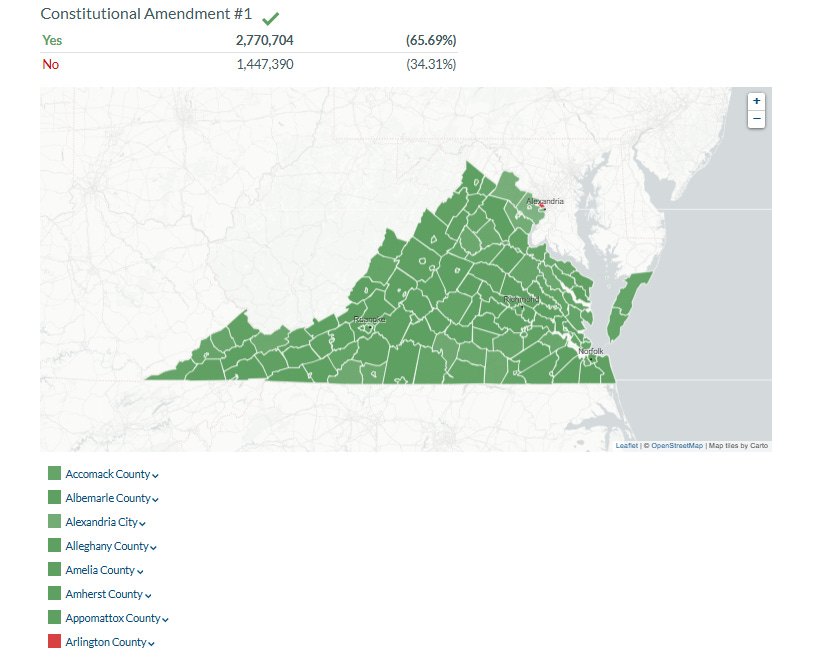
In 2020, I helped lead the Arlington Democrats in the No campaign on the amendment alongside my dear friend, the late great Cragg Hines, whom I served on the 8th Congressional District Committee. The Arlington Democrats overwhelmingly voted against it by 79% to 20%, and we went to the mat to make sure we delivered on it.
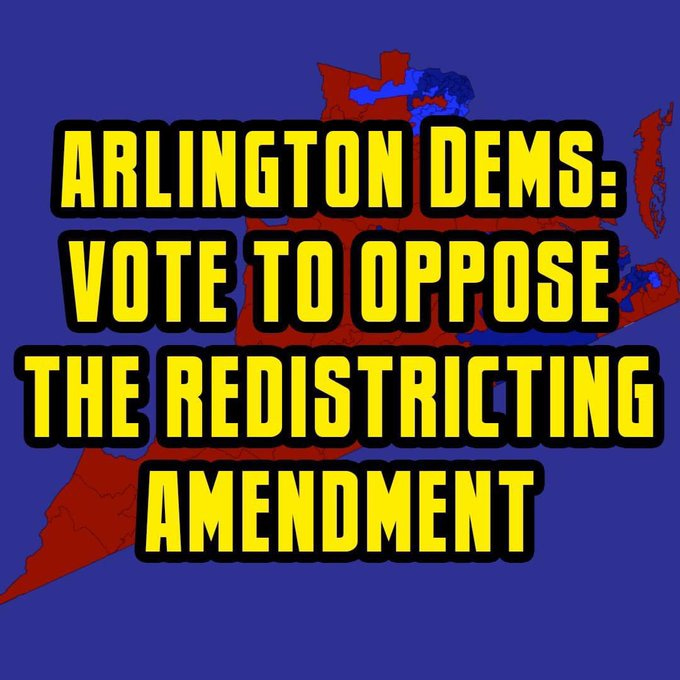
And we did. We lost the proverbial war in the end but Arlington Democrats won the battle. Arlington County was the only county to vote against this and was proven right for a number of reasons the very next year. That reasoning still holds true today and much like Cassandra in the legend of Troy, we are back to tell you the exact same thing:
Real independent redistricting means voters choose their representatives, not the other way around. Including sitting members of the General Assembly on the commission was inherently contradictory to that goal. They were in the room. They were the loudest voices in the room. And the citizen chair — the nominal signal of civilian independence — did not, as many of us predicted, defy the elected officials. The 2021 maps reflected that power imbalance.
And when those elected officials couldn’t agree — which they couldn’t, because a commission split evenly along party lines is structurally designed to deadlock — the maps went to the Virginia Supreme Court. Not to citizens. Not to an independent body. To seven justices, appointed through a process that is itself politically influenced, who drew maps that satisfied no one and settled nothing. That’s the legacy of the 2020 amendment: a commission that deadlocked, maps drawn by a court, and a process that ended up less democratic than the one it was meant to replace. The flaws weren’t theoretical. They played out exactly as critics warned.
When opponents of the 2026 amendment call Democrats hypocrites for now supporting mid-decade redistricting, they’re conflating two different things. We didn’t advocate for a bipartisan, elected-official-influenced commission enshrined in the state constitution. We advocated for an independent commission — exclusively civilian, nonpartisan in membership, with no party having a thumb on the scale. That’s not what we got.
We needed an amendment that handed the process to citizens and kept legislators out of it entirely. We got one that split the legislators down the middle and called it reform. And because we didn’t fix it then, we’re living with the consequences now.
Delegate Marcus Simon put it in terms that cut through all the procedural noise. He said: Sometimes when your kids are playing soccer, there’s an overzealous coach on the other sideline telling his players to throw elbows and smack kids in the mouth. Some people on the No side want us to just smile, keep everyone happy, and play clean while the other team plays dirty. But sometimes, you have to tell your kids: yeah, it’s not fair. Put your mouth guard in. Put your shin guards on. Lower your head. Get back in there and do what you need to do. That’s what we’re doing with this amendment. Because in normal times, we could do better. But we aren’t in a normal time — and we didn’t do better when we had the chance.
There are still Democrats who believe we should just win the right way. Grit and bear it. Play by the rules. I respect that instinct. It comes from a genuine place. But it misreads the moment entirely.
When Virginia Democrats first talked about redistricting reform, no one was anticipating a president who would openly pressure red states to gerrymander congressional maps just to consolidate one party’s power in the House. We weren’t planning for that. We were planning for a functional republic where the rules were shared.
We are not in that republic right now.
Isolationism — the idea that Virginia can just stay clean while other states get dirty — isn’t a virtue. It’s abdication. What happens in the House of Representatives affects every Virginian, regardless of which party drew the lines. We cannot afford to opt out because we can’t bring ourselves to do what is necessary.
None of this needed to happen. Trump’s zealousness made it necessary. It is profoundly unfair that the responsibility falls to state Democrats to clean up a mess made in Washington. But no one is coming to save us. Only we can step up.
Because what happens in Virginia on April 21st doesn’t stay in Virginia. The House of Representatives is currently operating on margins thin enough that a handful of seats determines what passes and what dies. Every seat Democrats don’t hold in the House is a seat Republicans do — and right now, several of those seats exist because Greg Abbott called a special session and drew them into existence without asking a single Texas voter.
The 2026 midterms are the first real opportunity to claw back the ground lost to Trump’s redistricting campaign. Virginia is part of that math. Maryland is part of that math. New York is part of that math. This referendum is not a local civics exercise. It is one piece of the most consequential redistricting fight since REDMAP — and the side that shows up on April 21st is the side that gets to influence what Congress looks like for the next four years.
I’ve spent a long time in Virginia politics. I’ve watched Democrats lose fights they should have won because they were too principled to get in the mud. This isn’t one of those moments.
As Senator Louise Lucas put it, with the kind of clarity that cuts through everything else: they started it, and we are fucking finishing it.
Vote yes on April 21st.
VA "vote YES" folks should be publicizing the Peter Thiel financed misdirection mailers coming out weekly. But WHERE ARE THE DEMS (again)?
This is the context people are missing. Read it.