

I Didn't Want to Leave. Then America Became My Home.
I took the citizenship oath at 25. Now the Supreme Court is deciding whether that promise still means anything.

This week’s By the Ballot is taking a bit of a detour and diving into the imprending SCOTUS decision on birthright citizenship tomorrow and we’ll be turning over the reigns to my good friend Camila.
Camila Alfonzo Meza is a communications and community engagement professional based in Northern Virginia. She currently serves as Engagement Manager at the Tysons Community Alliance, where she leads business and community programs, social media strategy, and partnership development. Active in Democratic politics, she serves as Co-President of Fairfax Young Democrats and has managed local campaigns in Fairfax County. A 2026 Northern Virginia 40 Under 40 honoree, Camila is bilingual in English and Spanish and is passionate about civic participation and inclusive community building.
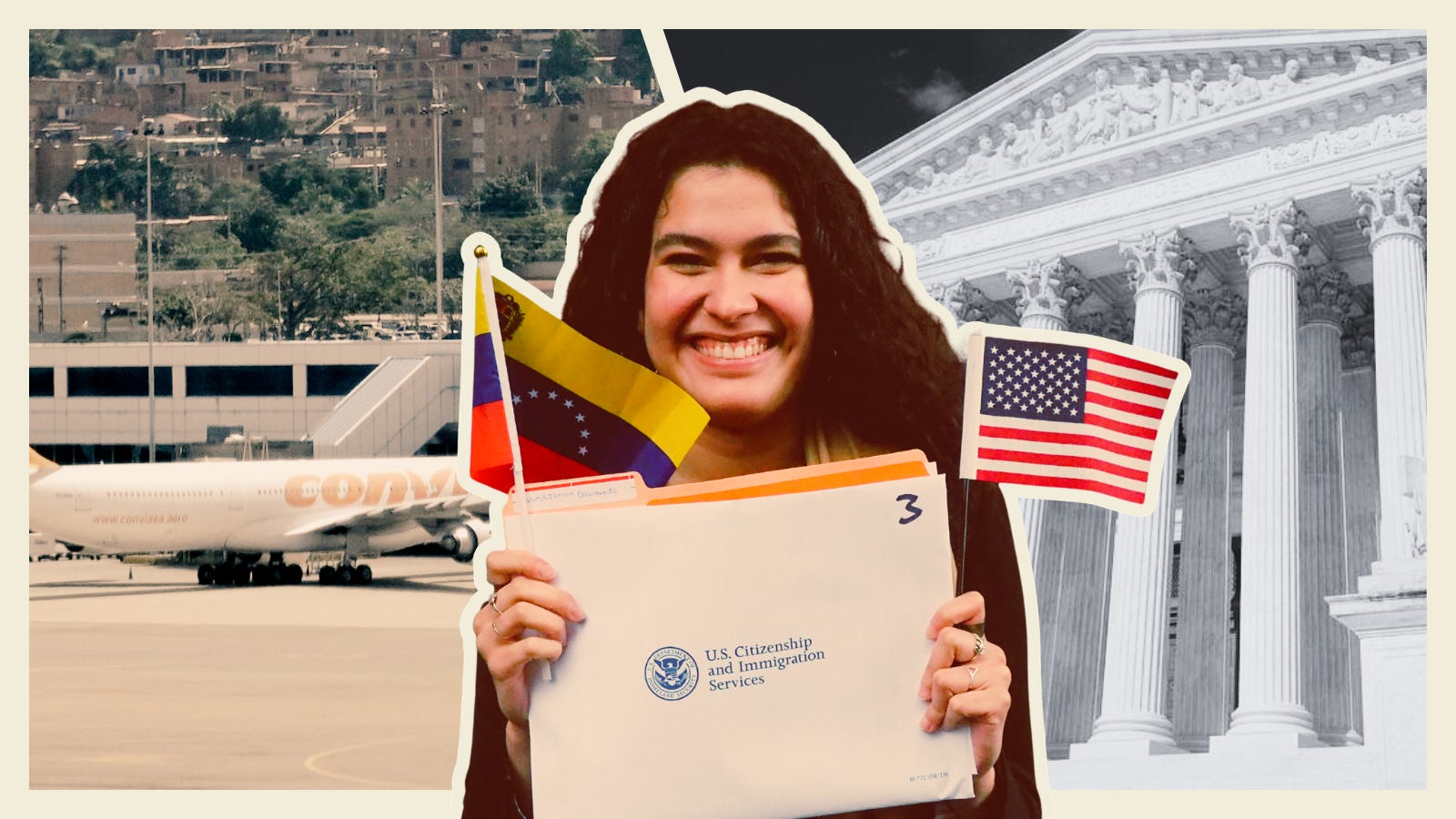
I am ten years old in Caracas when my mom asks what I think about moving to the United States. “No thank you,” I say. All my friends and family are here. This is where I belong. I have never once considered the possibility of living somewhere else. I had already been to Disney World, so what more could America possibly offer? I don’t give it much thought. Six months later, my mom tells me we are moving. I cry for weeks.
I am eleven years old in America. The plane ride is long, but I am not worried. I have my backpack stuffed with coloring books and my Game Boy. I press my face to the oval window and watch Venezuela disappear beneath the clouds, not fully understanding that I am watching it disappear from my life. For my birthday, my grandma gave me a journal. I love the embossed flower pattern on the cover and the navy elastic band that keeps it from falling open. “So you can write about your new adventure,” reads the note inside. “I will miss you.” I kept reading those four words the whole flight. I haven’t seen my dad in weeks. He came ahead of us to find a place to live and to get things ready for our arrival, to find some version of a life we could step into. At the airport, my mom’s eyes scan the crowd nervously until she finds him. His hair is longer than I have ever seen it. He looks thinner, too, or maybe just tired. They hug for a long time. I stand beside them holding my backpack, not sure whether to cry or smile, so I do a little of both.
Everything changed after that. A new language that lived in my mouth like gravel, words I had to practice in the mirror before school, sentences I rehearsed so I wouldn’t be laughed at. A new culture with rules I couldn’t always see. New friends who were kind but couldn’t quite understand where I had come from, or what I had left behind. An unfamiliar, and at times unforgiving, landscape: strip malls and highways where I had expected something more like the movies. But also an opportunity: a path where the future held real options and room to grow, where my parents believed hard work would be met with something resembling fairness. It was not an easy choice for my parents to make. They left behind their careers, their friends, their language, the small comforts that make a place feel like yours. But it was a hopeful one, and a brave one, and I have never stopped being grateful for it.
I’ve spent a lot of time reflecting on this journey. There is a profound sense of loss that comes with leaving your home country, a grief that doesn’t announce itself all at once but arrives in small, unexpected moments: a song on the radio, a smell that shouldn’t remind you of anything but does, a phone call with your grandmother where you realize you’ve started to forget the right words. You become a person who belongs fully to neither place: never quite American enough to avoid the question of where you’re really from, never quite Venezuelan enough for the family back home who have lived through things you only read about on your phone. Life moves on without you: the slang shifts, the inside jokes change, the relationships drift, until the place you feel homesick for no longer quite exists. It has become a version of home that lives only in you. You grow to love your new surroundings until they too become part of you, woven into who you are in ways you don’t always notice. But you remain always aware that your roots are elsewhere, that you carry a connection that cannot and should not be severed, and that this doubleness, this in-between-ness, is not a wound but a kind of inheritance.
Five years ago today, I became a naturalized U.S. citizen. In the midst of the COVID-19 pandemic, I took the oath in a room with other hopeful new citizens, six feet apart, all of us masked, none of us touching. There was no fanfare. A government official read the words, and we repeated them, and then it was done. Fourteen years of paperwork, renewals, waiting rooms, and uncertainty collapsed into a single quiet moment. My family waited outside, straining to catch a glimpse of me through the thick bushes lining the USCIS building. I was handed a certificate and a small American flag to mark the occasion. I walked out into the afternoon light and immediately registered to vote. I was 25 years old, and for the first time in my life, I felt like I had arrived somewhere I was allowed to stay.
In 2016, I started speaking my mind about politics, about the state of the world, about the direction the country was headed: posting online, showing up to meetings, signing things, saying things out loud that felt dangerous to say. “Be careful,” my parents told me. “We are guests here. It’s not safe.” I couldn’t blame them for feeling that way. They had spent years making themselves small, learning not to attract attention, understanding that their right to be here was conditional in ways that mine, as a child, had never fully registered. Being an immigrant means navigating an endless maze of paperwork, scrutiny, and uncertainty, always one form, one missed deadline, one policy change away from having the ground shift beneath you. Citizenship changed that for me. It gave me a voice, and the legal right to use it. But the fear my parents carried didn’t disappear with my naturalization certificate. The way people look at us, the way they talk to us: it has changed. And now we have a president who signals, loudly and without apology, that this kind of treatment is not only acceptable, but welcome.
That is what makes what happens tomorrow so personal. The Supreme Court will hear arguments in Barbara v.Trump, a case that could determine whether every child born in the United States is guaranteed citizenship — a right enshrined in the Constitution for over 150 years.
On his first day back in office, President Trump signed an executive order targeting birthright citizenship, seeking to strip it from all babies born in the United States after February 19, 2025, to parents without permanent legal status. If the Supreme Court allows it to stand, the consequences will be immediate and devastating.
Ending birthright citizenship would deny U.S.-born children of non-citizen parents—regardless of their parents’ legal status—the right to citizenship. This would leave many in legal limbo, creating a permanent subclass denied citizenship, legal identity, and fundamental rights. Even children whose parents hold legal visas could be subject to deportation, fracturing families and tearing apart communities.
President Trump has targeted immigrants since his first day in office, and his efforts to eliminate birthright citizenship are at the center of his cruel agenda to redefine who gets to be an American. But the 14th Amendment guarantees citizenship to children born in the United States — and President Trump is not above the Constitution.
For more than 150 years, the 14th Amendment has been unambiguous: if you are born on U.S. soil, you are a citizen. That promise has protected millions of families and allowed new generations to put down roots, build lives, and secure a future for themselves and those who come after them.
I was ten years old when I didn’t want to leave my hometown. I was twenty-five when I raised my hand and swore an oath to the country that had become my home. Birthright citizenship is not a loophole — it is a promise, one that has made journeys like mine possible for millions of people across generations. Stripping it away does not make America stronger. It makes America smaller. That promise is worth defending.
 | A guest post by
|
I certainly agree with you. Thank you for being so positive about the USA, and congratulations on your citizenship; it was just in time. I've attended a citizenship ceremony, and I wish more people would. I'm a citizen, but I've always been kind of apologetic about it. My sense is that a country is not like a football team, but more like a house—it needs a fresh coat of paint every once in a while. Right now, it's covered with mierda IMO. What I remember is how awful it was before we got in a bunch of industrious, talented immigrants after 1968. It was super boring before that; the food was awful, and it was getting even dumber. With the current exodus from our country, we will all be cousins at the rate we are going now.
My siblings and I were born abroad to US citizens. I have a birth certificate from a US embassy in a foreign country. I learned English from the kid next door after arriving in the US, and didn't like it much, even though we lived in a rich, leafy suburb. My sister, who was born while our parents were POWs, didn't have a birth certificate at all and had to go through naturalization in the 1950s. English is her second language, too, although neither of us is proficient in our original language anymore. From my point of view, I am shocked at the stupidity and venality of the anti-immigration, and now, Malthusian, movement. The 14th Amendment is a blessing, and I pray the Supreme Court doesn't cave to racist, jingoistic, chauvinistic solipsism.