

Papal Bulls on Parade: Leo against the Machine
Peter Thiel built an empire on Tolkien's lore. Last month the Pope used the same books to tell him he read them wrong.

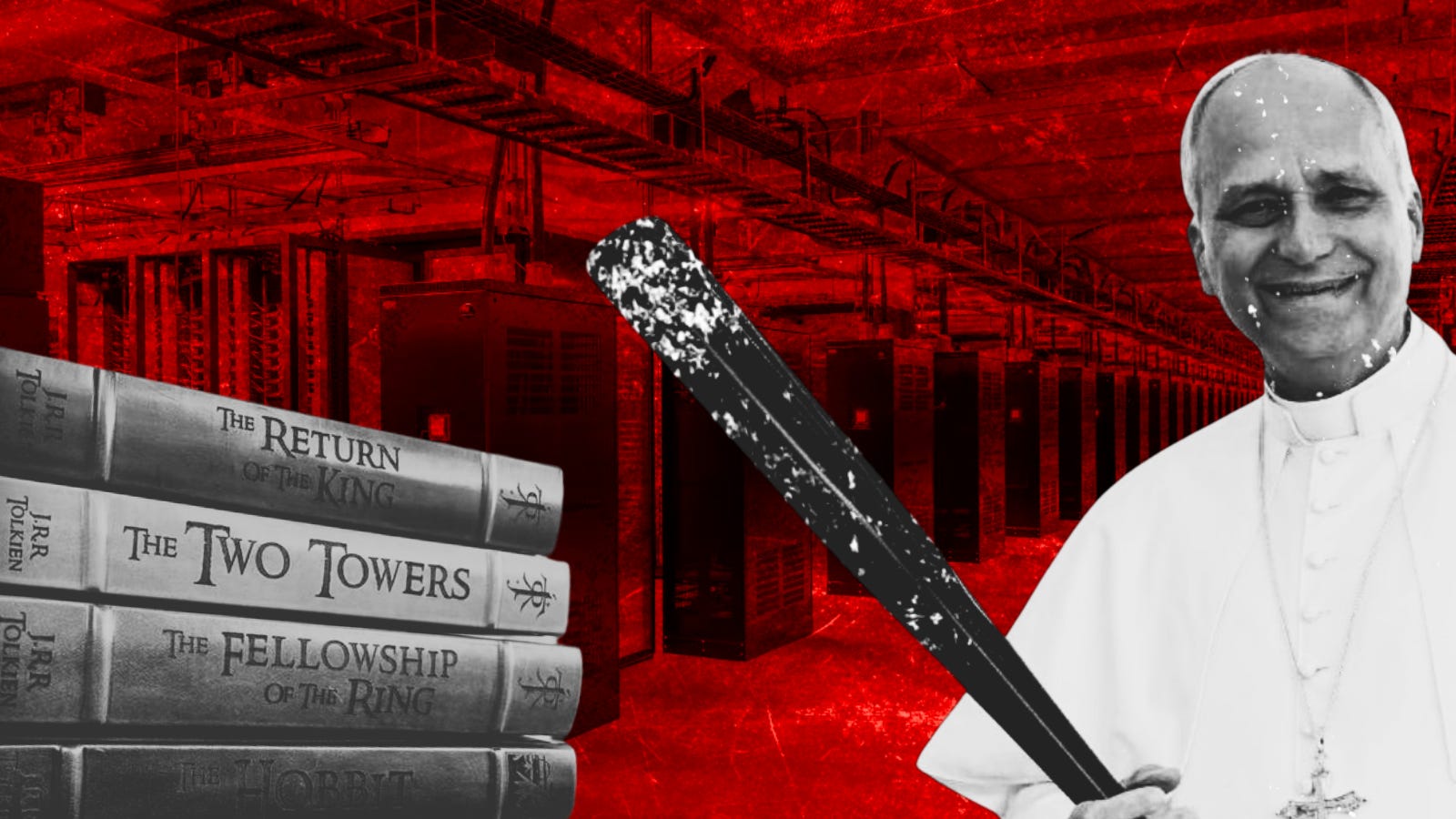
Peter Thiel named his surveillance company Palantir after the seeing-stones in The Lord of the Rings. His Founders Fund was an early backer of Anduril, named for Andúril, the sword reforged, the Flame of the West. The men building the digital nervous system of the American war machine reached into the same book for their branding, again and again, until Tolkien’s legendarium became a kind of private dialect for Silicon Valley power.
Here is the thing about the palantíri. In the story, they are not heroic. They are the instruments that corrupt Saruman and break Denethor, the cursed stones that bind whoever looks into them to the will of Sauron. They promise omniscient vision, and they deliver enslavement. Thiel named his omniscient-vision company after the cursed object that destroys the wise men who trust it, and either he didn’t notice or he didn’t care, and I genuinely cannot tell you which is worse.
Last month, the Pope read the same books. He read them the other way.
In his first encyclical, Magnifica Humanitas, signed May 15 and released May 25, Pope Leo XIV quotes The Lord of the Rings directly. Paragraph 213. Footnote 187 cites The Return of the King by chapter and page, which means a Tolkien passage now sits inside Catholic Social Teaching — the highest form of ordinary teaching the Church produces. The Pope reached into the same legendarium the founders raided for company names, and he pulled out the opposite lesson: that evil is uprooted not by powerful men holding powerful tools but by ordinary people doing ordinary, faithful work, “uprooting the evil in the fields that we know.” His own line, set down right after Gandalf’s, is that the civilization of love does not arrive in one spectacular gesture but in the sum of small and steadfast acts that hold the line against dehumanization.
The founders read Tolkien as a catalog of cool names for powerful tools. The Pope read him as a warning about what power does to the people who hold it. Same books. One of them was paying attention.
Technology is never neutral, and I learned that the hard way
The encyclical’s central claim is the one the founders will not quote, because it indicts the entire pitch. In his own words, Leo says AI cannot be considered morally neutral — that every technical tool embodies choices and priorities through what it measures, what it ignores, what it optimizes, and how it classifies people and situations. Ethical discernment, he writes, cannot stop at asking whether we are using a system for good or bad purposes. It has to examine how the system is designed, and what vision of the human person and society is embedded in the data and the models that guide it. Every design choice reflects a vision of humanity, meaning the people building these systems bear a particular ethical and spiritual responsibility for the vision they encode.
And here is how that responsibility gets laundered. No one is ever sold a worldview. You are sold a convenience — a faster checkout, a smarter feed, a free tool that saves you an afternoon — and the values ride in underneath it, encoded in design choices nobody put to a vote. The genius of the thing is that the cost stays invisible right up until the moment it isn’t, and by then the system is load-bearing in your life, and the question of whether you consented to its vision of you has quietly become moot.
Leo frames the danger through the oldest story we have about it: the Tower of Babel. A civilization drunk on its own reach, flattening every difference into a single uniform tongue, mistaking the ability to translate everything — including the mystery of a human person — into data and performance for wisdom. That is not a description of some far-off dystopia. That is the operating model of the company I handed my Social Security number to, and it is the operating model of the seeing-stone Thiel named his company after.
And Leo is precise about the human cost of being processed that way. Deep inner suffering, he writes, inevitably arises when the human person is reduced to performance, consumption, or a statistical datum. He says young people, in particular, now live under the yoke of expectations to perform, in an exasperating competitiveness that breeds anxiety and the fear of not measuring up. That is not a theological abstraction. It is a clinical description of what it feels like to be scored, ranked, optimized, and A/B tested by systems that know your data, not your name — and it is the cost that rides in beneath every convenience, invisible until it isn’t.
The mentality of power
Leo is blunter than popes usually allow themselves to be about where the power now sits. He writes that innovation used to be guided largely by the State, and that today the main drivers are private, often transnational actors with resources and reach that surpass those of many governments. Technological power, he says, has taken on an unprecedented and predominantly private character, which makes it that much harder to discern, to govern, and to direct toward the common good.
Read that with Palantir’s 2025 Army deal in your head. On July 31, the Army handed Palantir an enterprise agreement worth up to $10 billion over ten years — the largest in the company’s history — and folded 75 separate contracts into that single vehicle. Officials were careful to say the ceiling is a ceiling, not a commitment, and much of the work was already Palantir’s. But strip away the accounting, and the shape is unmistakable: a private company, named after a cursed object, wired ever deeper into the machinery of state violence — the targeting, the logistics, the real-time intelligence — and accountable to its shareholders, its founder’s politics, and very little else. The Pope did not name Palantir. He didn’t have to. He described the exact shape of the thing and let the shape do the work.
And he framed the whole choice as a binary; the entire encyclical turns on. Not enthusiasm versus fear. Not yes to technology versus no. The real choice, Leo writes, is between progress that serves individuals and peoples, and progress that subjects them to the mentality of power. A more moral AI, he warns, “is not enough if that morality is determined by a few.” Because AI tends to amplify the power of whoever already holds the resources, expertise, and access to data. The machine concentrates what was already concentrated. It hands more to the people who already had the most.
That is the part that makes this a labor document wearing the costume of a technology document.
A Pope named Leo, 135 years later
Pope Leo XIV signed Magnifica Humanitas on May 15 — the 135th anniversary, to the day, of Rerum Novarum. That is not an accident, and the man chose his papal name as a similar signal. Rerum Novarum was Leo XIII’s 1891 encyclical on the rights of workers, the document that founded modern Catholic social teaching, written when the Industrial Revolution was grinding agricultural and craft workers into factory labor and the Church had to decide whether it had anything to say about it. Leo XIII said capital must serve labor, not the other way around. He said a factory could not simply do whatever it wanted to the human beings inside it and call the result progress.
Leo XIV picked the name on purpose and signed on the anniversary on purpose, because he is making the same argument about the same kind of moment. The Industrial Revolution displaced the people who worked with their hands. The AI revolution is coming for the people who work with their minds: writers, coders, analysts, designers, and educators. And the encyclical refuses the easy line that this is simply the price of progress.
Leo writes that the new ways of working are not necessarily better ones. He writes that while AI promises to lift the burden of mundane tasks, in practice, it too often forces workers to adapt to the speed and demands of the machine, rather than building the machine to support the people who work. Technology should free human beings from drudgery. It should not throw them out of work in the name of cutting costs and padding profit. And then, in paragraph 155, in the same breath, the Pope expresses his hope for a “renewal of labor organizations.”
Sit with that for a second. The Pope just called for stronger unions in the age of AI. The head of the global Catholic Church looked at the most powerful technology of our lifetime and concluded that the answer lies in working people organizing. That is the most useful sentence in the document for anyone who actually cares about the dignity of work, and it is the sentence the tech press skated right past, because it cannot be turned into a product.
Here in this country, we have spent decades doing the opposite. We have right-to-work laws designed to break the bargaining power that the Pope just said we need more of. We have an economy that treats labor as the first cost to cut when a new machine arrives. The encyclical is not a Democratic talking point, and I am not going to pretend it is one. But when the Pope says capital must serve the worker and workers must be free to organize, he is making an argument that the American right has spent its entire existence fighting, and the American center has spent its recent history apologizing for.
He said it to their faces
He didn’t leave it on the page. On June 24, Leo gathered twenty-eight writers at the Vatican — Pulitzer winners, the Nobel laureate Jon Fosse, novelists from nearly a dozen countries — ostensibly to mark a hundred years of the Vatican’s publishing house. What he actually did was stand in front of the exact workers his encyclical said the machine is coming for, and tell them the Church still needs them. “We need your imagination, your narrative creativity, and your lively thinking,” he told them. Writing, he said, is an act of truth and revelation — it reveals who we are, what we believe and hope for, the world we strive toward.
The writers in the room heard it for what it was. Paul Elie put it plainly afterward: AI is a threat to literature, the Pope addressed it head-on, and the reason the world still needs writers is that we write as a free act, not as something an algorithm generated. Colum McCann said the Holy Father had been talking about storytelling, disarming language, and how AI has already penetrated the world of storytelling.
This is the encyclical’s argument made flesh. The abstract claim — that AI must serve the worker, not replace them for profit — was narrowed to a single trade and said to its practitioners’ faces. Writing is the canary. It is among the first kinds of human work the machine can convincingly counterfeit, which makes the people who do it among the first to find out whether anyone with power will say the counterfeit isn’t the same thing. The Pope said it. He said it to a room that builds nothing, sells nothing, and cannot be turned into a product.
The blessing they want and the one they ignore
Here is the tell, and it’s in who showed up. When the Vatican unveiled the encyclical on May 25, an AI lab sent a co-founder to stand beside the Pope on the dais — Anthropic, the one that markets itself as the conscientious objector of the industry, the lab that left OpenAI over safety and never lets you forget it. And here is the part that makes it more interesting than simple cynicism: the co-founder, Chris Olah, got up and admitted the problem. He said that every frontier AI lab, his own included, “operates inside a set of incentives and constraints that can sometimes conflict with doing the right thing.” Then he asked the Church to be the counterweight: “We need informed critics who will tell the labs when we are failing. We need moral voices that the incentives cannot bend.”
You can call that exactly what its critics called it within the hour — ethics-washing, pope-washing, a blessing rented for the price of a photograph — and you would not be wrong to. But notice what even the cynical reading concedes, and what the honest one makes unavoidable: a man who builds these systems stood in the Pope’s hall and said out loud that the incentives bend people, and that he needs someone the incentives can’t bend. The companies courting the blessing are admitting the Pope gets a vote. Leo took the handshake and named the stakes back to him: “What a great sign of hope it is that with our differences we can listen to one another.”
Thiel didn’t want the blessing. He reportedly told the Vice President to ignore Pope Leo on moral questions, the ethics of AI included — not to argue with the Church, but to tune it out entirely. That is the whole spectrum of seriousness in two gestures. One camp wants the Church’s stamp badly enough to admit, on the record, that its own incentives can’t be trusted. The other wants the Church switched off. And the man who wants it switched off is the one who named his company after the cursed stone, which tells you he already knows what the warning says, and would simply rather you didn’t read it.
What the machine cannot carry
Strip away the policy, and the encyclical comes down to one passage the founders cannot build around, no matter how much computing they buy. In his own words, posted from his own account, Leo wrote that artificial intelligences do not undergo experiences, do not possess a body, do not feel joy or pain, do not mature through relationships — that they may imitate or even simulate, but do not understand what they produce, because they lack the affective, relational, and spiritual perspective through which human beings grow in wisdom. It can wear our face. It cannot carry our soul.
That is the whole disagreement in a sentence. The men who named their companies after the seeing-stones believe the human person is a problem of insufficient data — that with enough access and enough compute, you can model the soul and then improve on it. The Pope, reading the same books they raided for branding, says the soul is not a modeling problem. He says humanity, in all its grandeur and all its woundedness, must never be replaced or surpassed, because what makes us human is precisely the capacity for relationship and love that no machine will ever hold.
The founders read Tolkien and saw the power of the palantír. They missed that the palantír is what destroys the men who use it. The Pope read the same passage, saw the warning, and then wrote it into the law of the Church.
That is not just a verdict on the machine. It is a verdict on every man who builds one to get richer, and on every preacher who blesses him for it.
TL;DR
Peter Thiel named Palantir after the cursed seeing-stones in The Lord of the Rings — the objects that corrupt and enslave the men who use them — and his fund helped seed Anduril, named for the Flame of the West, then both got wired into the American surveillance and war machine. Last month, Pope Leo XIV quoted the same Lord of the Rings in his first encyclical, Magnifica Humanitas, and read it the opposite way: as a warning that evil is uprooted by ordinary people doing small, faithful work, not by powerful men holding powerful tools. The encyclical argues that technology is never neutral, that it carries the values of whoever builds and funds it, that private tech power has now outgrown governments, and that the real choice is between progress that serves people and progress that subjects them to the mentality of power. Signed on the 135th anniversary of Rerum Novarum, it is a labor document in disguise: it says AI must serve workers rather than replace them for profit, and it calls for a renewal of unions in the age of the algorithm. Then, in June, the Pope gathered the writers — the workers, the machine counterfeits first — and told them to their faces that the Church still needs them. The machine can wear our face. It cannot carry our soul. The men building it read Tolkien as an aspiration. The Pope read it as a warning. One of them was paying attention.
As a Tolkien nerd, former pastor, and objector to most AI - this is one of my favorite articles you've ever written. Thanks for pulling all the threads together for people to see how interconnected everything is!
Excellent article!