

What’s Next: Is It Ever Really, Truly Over?
What April 21 Means for the Midterms

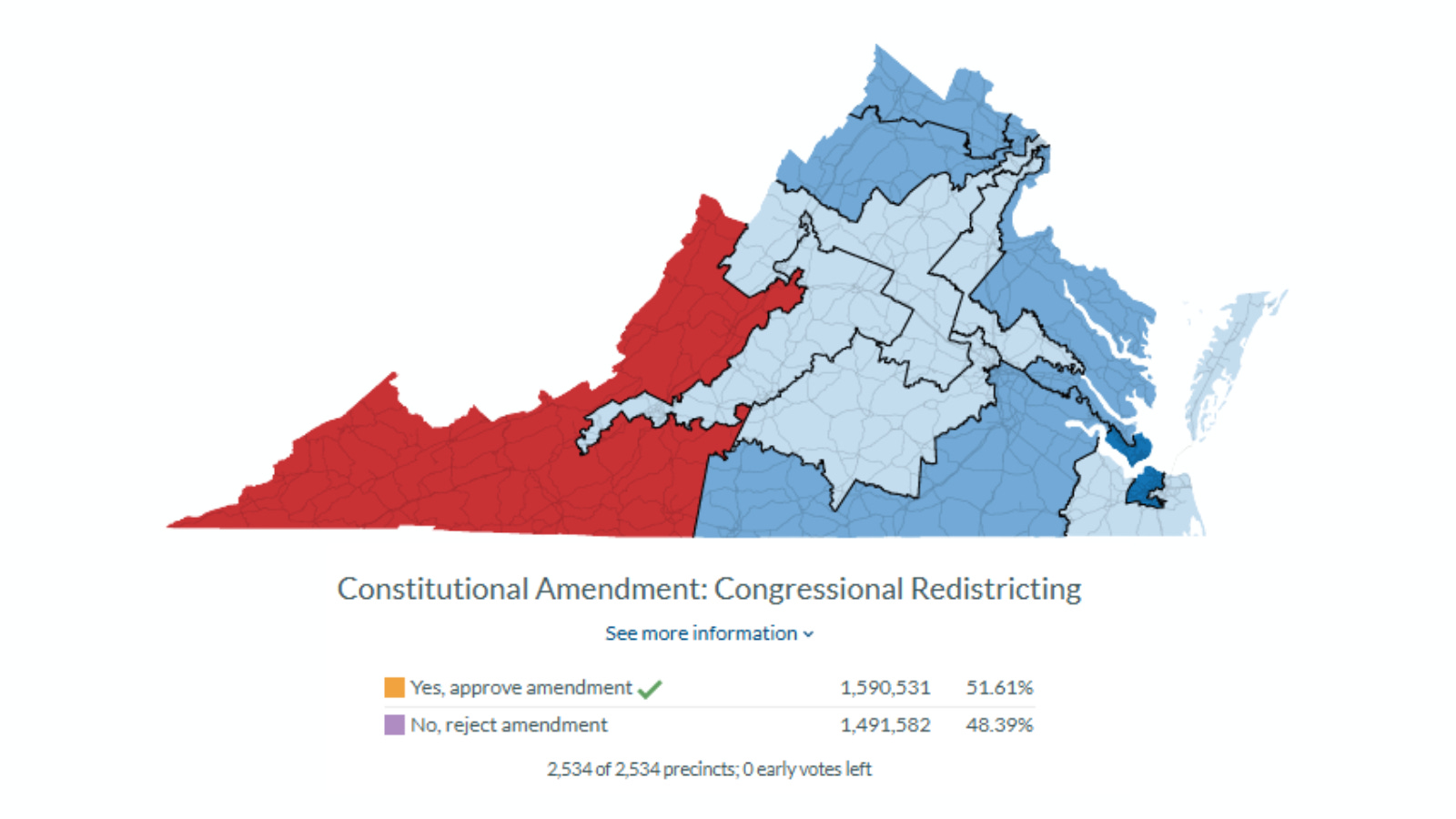
Well, Virginia, we did it. We officially joined California in the ranks of electorates that have taken the leap to do midterm redistricting to push back against Trump and his lackeys strong arming red states into drawing more Republican seats. (For more on that, reference my last piece on this.)
On a margin of just 3 points (51.44 - 48.56), Virginia voted to approve the amendment to allow for temporary redistricting, and based on the proposed maps drawn by the Virginia Legislature, give Democrats 4 more seats in Congress, bringing the Virginia Delegation from 6D - 5R to 10 fucking 1 D to R.
The margin of victory was significantly smaller than November’s, 3 points versus Spanberger’s 15. While the tightness of the vote was more than the Virginians for Fair Elections had hoped, the margins of victory in the places where the Yes Vote won were significant.
“Yes” won in 37 of 133 localities. In those 37 localities, “yes” won by an average 28.77%. The largest margin was in Petersburg, where it won by 73.78%.
The localities where Yes won big aren’t the story. The story is what we just barely beat to get there.
The Backlash to the Backlash to the Thing That’s Just Begun
Trump pressured red states to redraw their maps. California and Virginia responded with midterm redistricting of our own. That part of the chain has been covered. What hasn’t been covered is the third link: the operation that mobilized to stop us.
The No campaign wasn’t a grassroots concern about good government. It was a paid operation. Virginians for Fair Maps pulled in around $22 million, co-chaired by Eric Cantor and Jason Miyares. Justice for Democracy, the dark-money PAC running cover, took in another $6.9 million. $6.5 million of that came from a single shell called Per Aspera Policy Inc., which traces back to Peter Thiel. That’s 94 cents on every dollar Justice for Democracy raised. Glenn Youngkin personally chipped in over $500,000 of his own money. A.C. Cordoza, chair of Justice for Democracy, refused to say where the money came from. And then they flew in the talent: Scott Presler to call the amendment an “unconstitutional power grab,” Sean Spicer to lend whatever credibility he has left, and Meghan McCain to bring George Santos on her podcast to bash Abigail Spanberger.
Justice for Democracy spent some of that money on mailers to Black Virginia voters comparing the redistricting referendum to Jim Crow and the KKK. The NAACP called the ads “manipulative” and “racist.” Attorney General Jay Jones called them an attempt to suppress Black voter participation by exploiting the history of the Civil Rights Movement. That was the operation.
The same Scott Presler who two months earlier was in Indiana, threatening Republican lawmakers who wouldn’t gerrymander aggressively enough. The same Scott Presler who before that was in Utah, collecting signatures to dismantle that state’s anti-gerrymandering law. The hypocrisy isn’t incidental. It’s the operation.
This is what we just beat by 3 points. In one state. With Spanberger at the top of the ticket and 15 points of momentum behind us. The same operation, the same money, the same operatives, the same manufactured “power grab” framing, it’s loading up right now to fight the next blue state that tries this. And the one after that.
If California and Virginia are the only states that move, we absorbed the full force of that opposition alone. We did it on a 3-point margin. The next state to try this gets the same operation, just as well-funded, just as well-organized, with the added benefit of the lessons they learned watching us.
But if a third state moves, the operation has to split. Their money has to go two places. Their operatives have to pick which state to fly into. Their national press attention dilutes. A fourth state and the math gets worse for them. A fifth and it breaks.
Two states means we fought the whole apparatus alone. Three states splits it. Five states breaks it. The math isn’t optional. We need more Dems.
But more Dems is the external problem. There’s an internal one too. And the 3-point margin is where it lives.
Mind The 12-Point Gap
Here’s a number that should bother every Democrat in Virginia: 12.
That’s the difference between Spanberger’s margin in November (15) and the amendment’s margin in April (3). Same state. Same off-year electorate, more or less. Five months apart.
Twelve points evaporated.
Now, some of that was always going to happen. Ballot questions underperform candidates. They always have. People show up to vote for a person, not a paragraph buried halfway down the ticket. (If you’ve ever worked a polling location, you’ve watched it happen in real time. Voter walks in, votes for the top of the ticket, hands the ballot back, walks out. Gov, Lt. Gov, AG, done. They didn’t even see Question 1.)
But 12 points isn’t drop-off. 12 points is something else.
Spanberger won 64 of 133 localities. The amendment won 37. Do the math on that. There are at least 27 localities in Virginia where voters showed up for a Democratic governor in November and then either stayed home in April or voted no on giving her the tools to do the job they elected her to do.
Let’s be precise about what that means. The base showed up. Where Yes won, Yes won big. Petersburg by 73 points, an average margin of nearly 29 in the 37 localities we carried. That’s the Democratic base loud and proud. The base isn’t the problem.
The problem is the ring around the base.
The exurbs. The small cities. The Spanberger-curious moderates who broke for her in November because she’s a former CIA officer and a serious person and not whatever Winsome Earle-Sears was offering. They liked the candidate. They were not, it turns out, sold on the project.
That’s the 2026 problem in one sentence: the voters we need to hold the House aren’t sold on the project. They’re sold on the candidates.
(And before anyone in my mentions starts in on it: no, this isn’t a screed against the voters. The voters did the work in November. The voters showed up again in April, in an off-year, on a single-issue ballot question, in numbers that would have been unimaginable a decade ago. Turnout wasn’t the failure. Persuasion was.)
Somewhere between November 4th and April 21st, the No campaign successfully convinced enough Spanberger voters that giving Democrats four more seats in Congress was a “power grab” rather than a response to one. They had $29 million and Jim Crow mailers and Scott fucking Presler to do it. We had a 15-point governor and the truth.
The truth wasn’t enough. The truth was enough by 3 points.
Read that again. The truth was enough by 3 points.
Three points is also, for whatever it’s worth, a wider margin than Glenn Youngkin won by in 2021. The man who spent his post-governorship trying to kill this amendment, who personally cut a $500,000 check against it, who held rallies and did Fox hits opposing it, lost the referendum by a margin larger than the one that put him in the governor’s mansion in the first place. That is not a footnote. That is the headline they don’t want printed.
If we walk into 2026 thinking the truth will carry us, we are going to lose seats we should hold. The voters who got us to 51.44 are the same voters who’ll decide the Second, the Seventh, the Tenth. And now the First, the Fifth, and the Sixth. And they are not on autopilot. They have to be persuaded every single time. With every cycle. About every single fight.
That’s the warning. Read the margin.
The persuasion was the failure. And persuasion isn’t an ad budget. Persuasion is what you’ve delivered when you ask for the next vote.
The Bill Comes Due
Here’s the thing about asking voters to give you four more seats in Congress: at some point, they’re going to ask what you did with them.
Not in 2026. Not on day one of the new majority. But sometime between now and the next time we need them to show up for a structural fight, the voters in those 27 localities, the ones who broke for Spanberger but balked on the amendment, are going to want a receipt. They’re going to want to know whether the four seats we just spent $64 million and three points of margin to get were worth the trouble.
That answer is on us. Not on Trump. Not on Mike Johnson. Not on the No coalition. Us.
(And before the “but the filibuster” crowd starts in: yes, I know. We’re talking about a House delegation, not the Senate. Stay with me.)
What does delivery look like? It’s the question Democrats have been bad at answering for a decade. We are very good at telling voters what we are against. We are very good at telling voters what they are against. What we have not been consistently good at, especially in Virginia, is telling voters what they are going to get when they hand us power.
So let me try.
A 10-1 delegation means four more Democratic votes for Medicare for All. It means four more votes for the PRO Act. It means four more votes to bring the rampant, unaccountable ICE activity tearing through our communities to a halt. And it means four more votes to finally put a real check on the Trump Administration, instead of negotiating against ourselves while he tests every guardrail left.
That’s the project. That’s what we asked Virginians to vote yes on, even if we didn’t say it out loud. The map was the means. The delivery is the end.
And here’s where I’m going to say something that’s going to get me yelled at in the replies: Democrats in Washington have a delivery problem that predates this referendum.
We have spent the last decade winning majorities, losing them, winning them back, and presiding over a government that still hasn’t passed Medicare for All, still hasn’t passed the PRO Act, still hasn’t reined in the deportation machine, and still spends more time managing Trump than stopping him. We have had the votes at moments that mattered. We have not always used them.
That track record is what made the 12-point gap possible. The Spanberger voters who skipped the amendment weren’t fooled by Peter Thiel’s mailers. They were unconvinced. They looked at the case for giving Democrats more power and they said, in effect, “show me what you did with the power you already had.”
That is a fair question. It is the question.
Let me be specific, because vague self-criticism is just self-flagellation with extra steps.
In 2009, Democrats had the White House, the House, and 60 votes in the Senate. We passed the Affordable Care Act, which is real, which saved lives, which I will defend until I am in the ground. We also let the public option die in committee because Joe Lieberman wanted to be courted. We declined to codify Roe when we had the runway. We had the most progressive trifecta of my lifetime and we governed like we were borrowing the keys.
In 2021, Democrats had the White House, the House, and a 50-50 Senate with a tiebreaker. We passed the American Rescue Plan, the Inflation Reduction Act, the bipartisan infrastructure law, and the CHIPS Act. Real bills. Real money. Real delivery. And we also watched Build Back Better get gutted by Joe Manchin and Kyrsten Sinema while leadership negotiated against itself for eighteen months. We watched the John Lewis Voting Rights Act die because we wouldn’t blow up the filibuster to save it. We watched Medicare expansion get traded for an electric vehicle tax credit because Manchin’s spreadsheet said so.
(I’m not relitigating the 2021-22 cycle to make anyone feel bad. I’m relitigating it because the voters in those 27 localities lived through it. They watched it happen in real time. They are not stupid. They remember what got passed and what got dropped. And when the No campaign told them that giving Democrats more power doesn’t actually translate into Democrats using power, they had four years of receipts to back the claim up.)
This is the part that makes me angriest, and I want to be honest about it: we keep treating delivery like it’s a separate problem from messaging. It isn’t. Delivery is the message. When we passed the ACA, we didn’t have to explain to voters what the ACA was. They felt it. When we failed to pass voting rights, we didn’t have to explain that either. They felt that too.
The voters who gave Spanberger 15 points and gave the amendment 3 are not confused about what Democrats are for. They are confused about whether Democrats can do what Democrats are for. And every cycle we hand them another round of “we tried but Manchin,” another round of “we’ll get it next time,” another round of leadership press conferences explaining why this wasn’t the moment, the gap gets wider.
The 12-point gap isn’t a polling problem. It’s a trust problem. And you don’t fix a trust problem with a better ad budget. You fix it by doing the thing.
(I’ll say it the way Senator Lucas would: they started it, and we are fucking finishing it. But finishing it means actually finishing it. Not just winning the seats. Using them.)
So here’s what delivery looks like in practice. It looks like the new 10-1 delegation walking into Washington and voting like they mean it on every single one of the bills above, even when leadership tells them to wait. It looks like Spanberger spending political capital on the fights that hurt instead of the fights that poll well. It looks like every Democrat in this state, from Richmond to the Ninth, treating the next 4 years like the audition they are.
Because here’s the part nobody wants to say out loud: the 10-1 map isn’t permanent. It’s temporary. It expires after the 2030 census. We have between now and then to convince Virginians that we earned it. That we used it. That when we asked them for the keys, we drove somewhere worth going.
If we do, the next structural fight is easier. The next blue state that tries this has a model. The 12-point gap closes. The base grows. The ring around the base gets pulled in.
If we don’t, we hand the No campaign their next ad. They asked you for four more seats and gave you nothing. And the next time we need to ask voters to show up for the project, they will remember. They always do.
So to every Democrat reading this who is celebrating today: good. Celebrate. We earned it. We beat $29 million, Jim Crow mailers, Scott Presler, Sean Spicer, Meghan McCain, Eric Cantor, Jason Miyares, Glenn Youngkin’s checkbook, and Peter Thiel’s shell company. That is not nothing.
But Wednesday morning, we go back to work. Because the win isn’t the win. The delivery is the win.
Give people a reason to vote for us, not just against the other guy.
That’s the whole job. That’s always been the whole job.
The map gave us the seats. The seats are not the point.
The point is what we do with them.
TL;DR
Virginia approved midterm redistricting by 3 points, taking the delegation from 6-5 R to 10-1 D. The win is real. The margin is the warning.
The amendment passed by a wider margin than Glenn Youngkin won the governorship by in 2021. He spent half a million dollars of his own money trying to kill it.
The No campaign was a $29 million paid operation funded by Peter Thiel through a shell, fronted by Cantor, Miyares, Youngkin, Presler, Spicer, and McCain. We beat it alone. The next blue state that moves splits the operation. The fifth state breaks it. We need more Dems.
12 points evaporated between Spanberger’s November margin and the amendment’s April margin. The base showed up. The ring around the base did not. That’s the 2026 problem.
The voters we need to hold the House aren’t confused about what Democrats are for. They’re confused about whether Democrats can do what Democrats are for. The 12-point gap isn’t a polling problem. It’s a trust problem.
The 10-1 map is temporary. It expires after 2030. We have between now and then to convince voters we earned it by using it. Medicare for All, the PRO Act, ending rampant ICE activity, and putting a real check on the Trump Administration is what delivery looks like.
Give people a reason to vote for us, not just against the other guy. The map gave us the seats. The point is what we do with them.
Excellent observations, Matt
Spot on. Love this. "But Wednesday morning, we go back to work. Because the win isn’t the win. The delivery is the win.
Give people a reason to vote for us, not just against the other guy.
That’s the whole job. That’s always been the whole job.
The map gave us the seats. The seats are not the point.
The point is what we do with them."