

Dark Money’s Death Knell for Democracy
Groups funneling money into anti-progressive movements spell doom for progress.

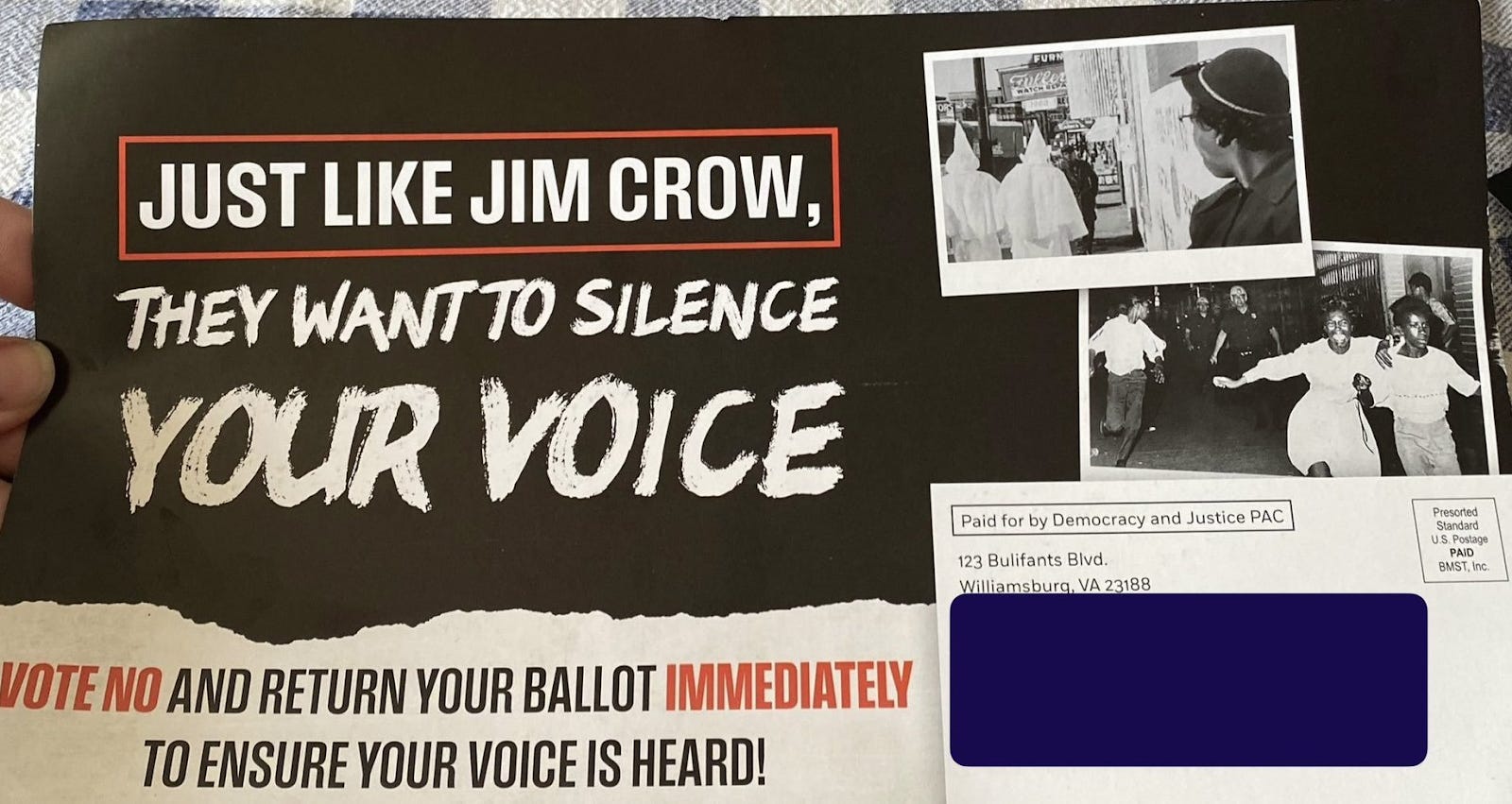
On March 7, a mailpiece bearing an alarming message hit the mailboxes of likely Democratic voters across the Commonwealth. The message was from an alleged PAC called “Democracy and Justice PAC,” which showed photos of people dressed in KKK robes marching through the street and Black people fleeing police officers, accompanied by the messages “Just like Jim Crow, they want to silence your voice” and “vote no and return your ballot immediately to ensure your voice is heard.”
The visceral reaction to these mailers was immediate and swift. Condemnation, along with social media posts refuting the claims that the redistricting amendment was harmful to communities of color, came at a mile a minute. But it all came down to the same questions: who was behind this campaign, and who thought these mailers were acceptable?
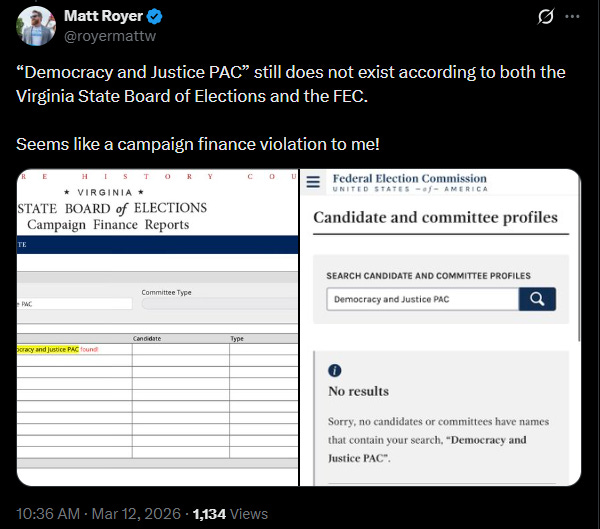
A cursory search of this PAC yielded no results on Virginia’s State Board of Elections or the Federal Election Commission’s database. This lack of campaign finance data and filings persisted even a week later
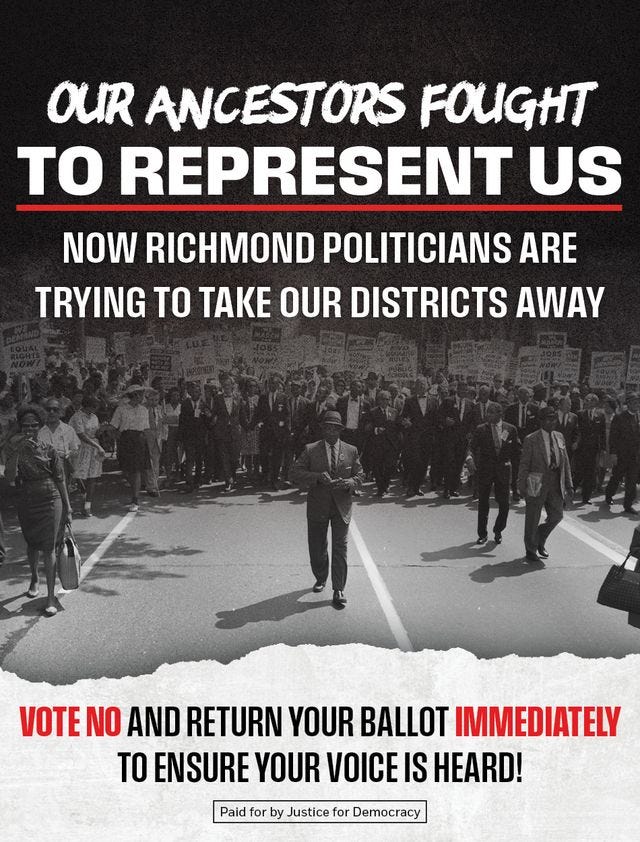
On the same day the mailer dropped, similar voters received a text message with graphics styled identically to the mail piece. This time the message read, “Our ancestors fought to represent us. Now Richmond politicians are trying to take our districts away.” This message came from a group named Justice for Democracy, which did have a paper trail.
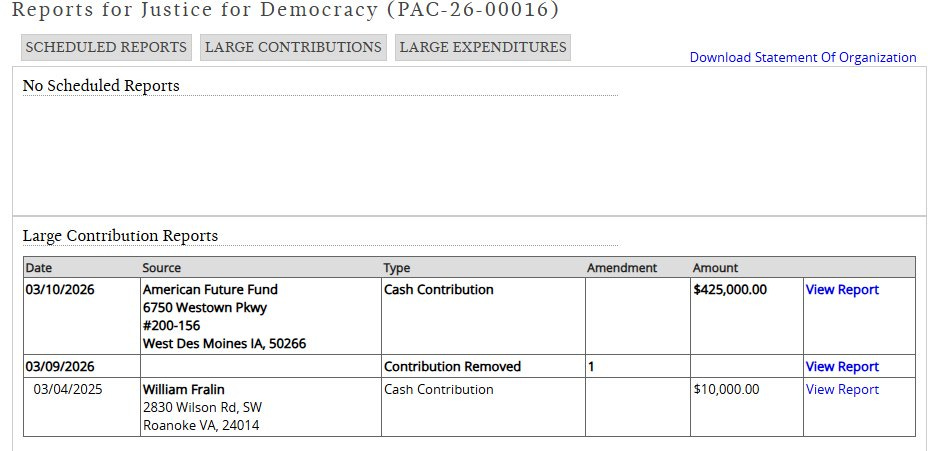
Its treasurer was listed as Christopher Woodfin, and its address matches that of WoodfinLaw, which has been listed as “Legal Services” for various Republican candidates across Virginia, earning over $366K over the past eight years. According to their statement of organization — which is public on VA ELECT — the group was created just four days before the mailers dropped and had only one large contribution reported: a $10,000 donation from former GOP Delegate William Fralin Jr. of Roanoke, which was later found to have been mistakenly reported. That’s a significant sum to misreport.
This sparked inquiries from journalists in the Richmond press corps, including Markus Schmidt from the Virginia Mercury, who reached out to politicians in Richmond for comment and, more importantly, to the man listed as the group’s treasurer, Chris Woodfin.
“Due to attorney-client privilege concerns, I cannot speak on any of my client’s activities short of confirming that they are a client,” Woodfin wrote to Schmidt. “I will forward your information to my clients.”
The man behind it all then revealed himself when former Delegate AC Cordoza reached back out to Schmidt with a statement: “Richmond politicians have ripped apart majority minority districts in order to increase the number of white representatives from northern Virginia. Dan Helmer, Don Beyer, and others diluted the African American vote strength to increase their own power. Plain and simple, some things never change. They help themselves, my community gets left behind.”
Later that week, Cordoza held a solo press conference, where he continued delivering the same message. “This mailer is the backlash. And they’re having a hard time dealing with it because it reflects upon them, and they’re not used to being held accountable,” he said, referencing Virginia Democrats. “And one of the biggest messages I have for the people in Richmond who are upset about this mailer is, ‘grow up.’ This is what accountability looks like.”
But beyond the question of who was behind it came the question of how they were getting — and spending — so much money. A longer review of the group’s reports hit pay dirt when a new $425,000 contribution appeared on March 10, 2026, from the American Future Fund, a 501(c)(4) located in Des Moines with a very sparse website.
The American Future Fund was founded in 2007 by Nick Ryan, a former aide to Bush OMB Director Jim Nussle, and has reportedly taken money from the Koch Brothers, other energy industry interests, and a lobbying group for Big Pharma.
This same group sued the New York Board of Elections just last year because they did not want to disclose the donors behind a slew of anti-Mamdani ads calling the then-candidate an extremist. And that’s because 501(c)(4)s are frequently used to obscure large donations from wealthy donors, corporate interests, and sometimes nefarious organizations — essentially laundering money toward candidates. The funding won’t be linked to any specific influences until tax information is made available. So what incentive do they have to disclose those donors if the entire point is to hide them?
The group stated at the time in their lawsuit:
“AFF does not wish to comply with New York’s burdensome registration and enforcement requirements because AFF’s donors reasonably fear physical and professional reprisals, including threats, harassment, and reprisals, as well as economic retaliation, for their political speech and associations. By requiring AFF to disclose its donors simply because it proposes to speak on issues of local and national importance, AFF and its contributors’ ability to associate and speak through the act of contributing are unconstitutionally and unlawfully abridged.”
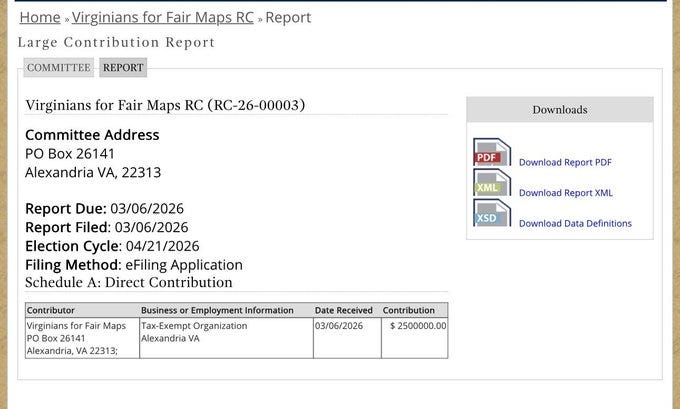
Virginia is a breeding ground for dark money campaigns like this, where the donors behind big-money spends are never exposed, thanks to the state’s lax campaign finance laws. And with money pouring in for Democrats from party leadership in DC and the National Democratic Redistricting Commission, the opposition is getting desperate. Earlier that same week, Virginians for Fair Maps moved $2.5 million from their affiliated 501(c)(4) to their PAC to skirt those same donor disclosures.
The result of this much dark money moving around elections is predictable: astroturfed campaigns that try so hard to mimic the authenticity of their targeted audience that they tip their hand. But when you scratch the surface, you find they’re propped up by nothing but large paydays and hollow values. A real, passionate candidacy resonates with voters when you can see that those advocating for it truly believe what they say. When you only have facetious talking points and paid-for faces, that passion doesn’t translate.
This is hardly the first time, and it won’t be the last — not until the Virginia General Assembly requires stricter campaign finance disclosures. And that begs a bigger question: why did it take investigative journalists to gain any real insight into a group spending hundreds of thousands of dollars on an election? How can groups like these spin up in a matter of days and manipulate our elections without offering even the slightest transparency about who is funding them? And how is that dark money undermining our electoral process and progress — not just across the aisle, but in intra-party fights as well?
Digital Mercenaries against Abu
Around the same time this was unfolding in Virginia, another C4-funded campaign against a Democratic candidate was underway in Illinois. Journalist-turned-social-media-influencer Kat Abughazaleh, best known by her Twitter persona @KatAbu, was the progressive favorite in Illinois’s 9th Congressional District to replace retiring Congresswoman Jan Schakowsky. About a week before the primary, the number of social media influencers posting content in opposition to her candidacy skyrocketed.
As Brandy Zadrozny from MSNow reported, social media influencers received emails from a group called Democracy Unmuted offering them $1,500 to participate in a “Voter Awareness Campaign” with the stated goal of encouraging “voters to look past viral personalities and ask real questions about who is running and why.” But the $1,500 was for a single post with a very specific message: go negative on Kat Abughazaleh.
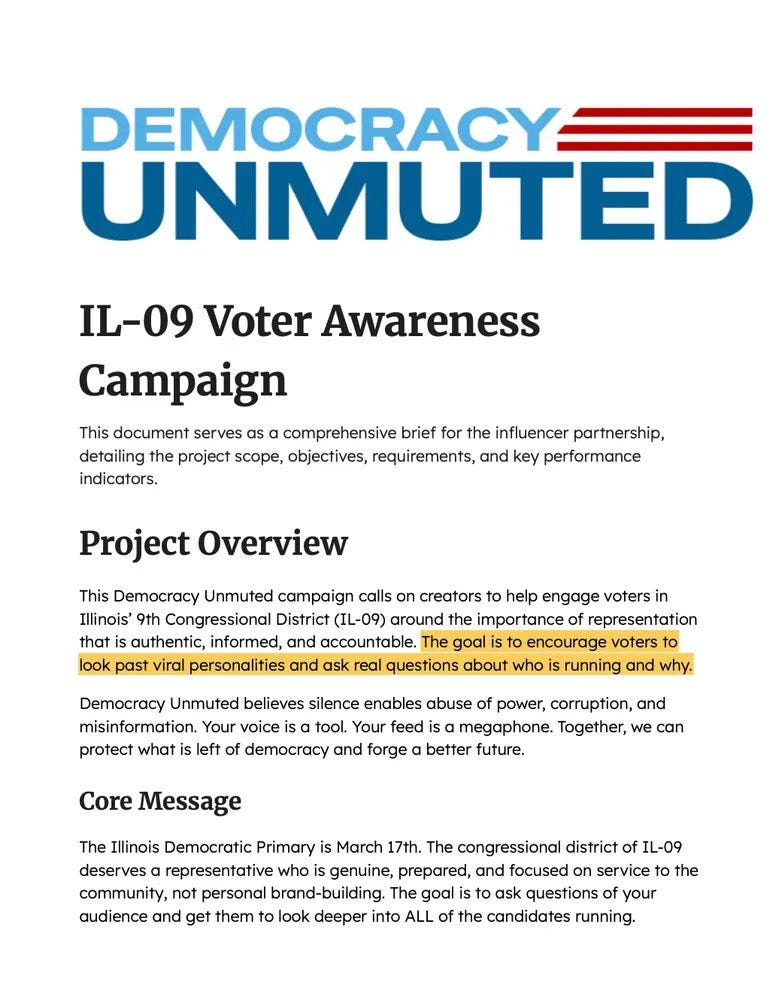
Their now-archived website had no information on who was running the group or what its broader purpose was, and it had only been registered two weeks before the messages were sent out. It carried only the slogans: “Do the right thing,” “ICE raids in our neighborhoods,” “Strongmen plays in Venezuela,” “War drums in Iran,” and “this is what happens when power goes unchecked.”
A very odd message for an organization seemingly only involved in opposing one Democratic candidate in a crowded primary of 15.
Their call to action read: “We are all influencers. Your voice is a tool. Your feed is a megaphone. Your silence is a choice. Stand up. Speak out. Protect what’s left of democracy, and forge a better future together.
Again — this was directed against one Democratic woman who has a remarkably strong track record of opposing fascists in her hometown of Chicago. She was, in fact, under federal indictment at the time for protesting ICE’s overreach in October 2025. The people funding this campaign were not, however, using their money to oppose the fascist authoritarians in the streets they referenced — the ones Abughazaleh had actually been protesting
Conspicuously absent from the website: who was leading this organization and who was funding it.
The group sent influencers a brief asking them to “highlight more than one” of Abughazaleh’s alleged disqualifications: she is inexperienced, comes from a wealthy family, may live with her partner in a different neighborhood, and is too new to the area to serve. It continued, “Kat’s campaign appears designed for attention rather than impact.” In exchange for a single post, each influencer would receive $1,500 — a significant sum, especially for those with a modest following who may not be able to leverage in-platform monetization.
Upstart Factory, a digital marketing agency, was tasked with distributing the brief and recruiting influencers to post — adding yet another layer to the mounting coverup of who was actually behind the campaign, making the already opaque process even harder to see through.
Many of these influencers read word-for-word from the brief, sometimes not even knowing how to pronounce Abughazaleh’s name — as in a clip from Justin Kralemann, aka “thewokeginger,” whose entire shtick appears to be having red hair and wearing a hat that says “woke” on it. Kralemann notably lives in Missouri and has no connection to Illinois’s 9th Congressional District, raising more questions than answers about why he was weighing in so heavily and quoting the brief verbatim.
He removed the post shortly after receiving pushback online, and when reached for comment by Zadrozny, Kralemann stated that he “wasn’t paid for this content” and that “shortly after posting, I realized it did not meet the standards I’ve set for my platform, so I removed it. I want to sincerely apologize to Kat Abughazaleh and wish her the best of luck in the upcoming primaries.” Which raises the question: did he actually do the research he was urging his followers to do and realize he was wrong — or did the check just not clear?
It was Astroturfing 101, funded by large-scale dark money. But if you were a casual observer who didn’t know what you were looking at, you’d genuinely believe a large swath of the online population was against Kat and her candidacy. Yet one thing was never revealed: who was doing this and why.
Many speculated it was AIPAC or AIPAC-aligned groups cracking down on candidates in Illinois who had been vocal in their support for Palestine and their condemnation of Israel’s genocide in Gaza. Others suspected it came from more centrist leadership within the DCCC in Washington, who didn’t want more progressive candidates winning out.
No one has claimed responsibility, and no one has been able to identify the funding sources behind the promised payments. But one thing is certain: the voters of IL-09 were kept in the dark, and Kat’s candidacy suffered for it. She came in second out of 15 candidates — by 4,141 votes.
Were the 11th-hour attacks the cause of her loss, or were the attacks launched in response to her surge in pre-election polling? It’s a difficult chicken-or-the-egg question, and the uncertainty only compounds when there’s no explanation and no accountability.
And unfortunately, this isn’t the only Democratic or centrist faction pushing dark money into the influencer world.
A Chorus of Moderates
On the heels of the 2024 presidential cycle, Democrats watched as the manosphere podcast and online dude bro brainrot meme strategy carried Trump to a second term and knew they were on the back foot. Many Democratic Party members, myself included, were clamoring for the party to exponentially expand what former Vice President Kamala Harris’s campaign had attempted in 2024: reach deeper into the digital online world where so many young people first engage with politics. Harris’s team played it somewhat safely, but it was still a much-needed improvement over past campaigns that didn’t want to acknowledge “new media types” at all.
Democrats had struggled to court the online world throughout the Biden presidency. The push to ban TikTok had alienated many Gen Zers. The White House had turned away several content creators from collaborating because they had criticized the administration’s handling of climate change and the conflict in Gaza.
What people wanted wasn’t for Democrats or politicians to reinvent the wheel and produce solely online political content — they wanted engagement with established digital influencers who had young, impressionable audiences that trusted them and would listen when they introduced a candidate or an issue.
Democratic politicians started going on podcasts. The DNC and allied organizations began engaging in online discourse, using humor and memes the way their younger members did. Candidates and progressive organizations began reaching out to non-political social media influencers to collaborate on content. But it was clear that Democrats were at a serious monetary disadvantage to Republicans, who had spent decades cultivating a media landscape with a cult-like following — one that now reached directly into people’s phones.
Then, between 2024 and 2025, a wave of political social media influencers emerged seemingly out of nowhere. They talked exclusively about politics, but very few had any prior involvement in Democratic Party politics or activism. And almost uniformly, they were pushing a moderate position on most issues — sometimes clashing directly with more progressive accounts online who had criticized Biden and Harris for not doing enough. Some were even pushing lines you were more likely to hear on CNN than on Twitter or TikTok.
In August of 2025, Taylor Lorenz broke a long-suspected pay-for-play scheme involving many of these notable left-leaning influencers. Lorenz reported that dozens of Democratic political influencers and content creators had received contract proposals from a dark money group named Chorus, being offered “$8,000 per month to take part in a secretive program aimed at bolstering Democratic messaging on the internet.”
The influencers receiving these proposals included recognizable names like Aaron Parnas, Olivia Julianna, Suzanne Lambert, and Leigh McGowan (aka Politics Girl), along with many others you’d encounter scrolling your “For You” page as an engaged political Millennial or Gen Zer on Twitter, TikTok, or Instagram.
Among other stipulations, these influencers — whose combined follower count was at least 13 million — were not allowed to discuss the money they received from Chorus and were limited to the political content Chorus approved for them to create.
Unlike in the Illinois case, we do know where Chorus’s money came from: the Sixteen Thirty Fund, a notable C4 that, like others of its kind, does not disclose its donors. As Politico put it, this arrangement “illustrates the extent to which the left embraced the use of ‘dark money’ to fight for its causes in recent years.” The fund notably spent $410 million in the 2020 election to unseat President Donald Trump and win a Democratic majority in the Senate.
I want to make one thing perfectly clear. As long as there is money in politics and we have no limits on spending or on where money comes from, it will unfortunately be a game of “if you can’t beat ‘em, join ‘em.” Disarming ourselves while Republican and Far Right groups utilize giant swaths of money to push their regressive messaging will only hurt us in the long run. But in the case of Chorus, it’s not so much the money as it is the lack of transparency and the messaging being dictated to those they contract with.
Creators in the program are not allowed to use any funds or resources they receive through the program to make content that supports or opposes any political candidate or campaign without express written authorization from Chorus in advance. Acccording to copies of the contract viewed by WIRED, influencers are also prohibited from disclosing their relationship with Chorus or the Sixteen Thirty Fund — or, functionally, that they’re being paid at all. They are further forbidden from “disclos[ing] the identity of any Funder,” and Chorus retains the ability to force creators to remove or correct content based solely on the organization’s discretion, if that content was produced at a Chorus-organized event.
Chorus is headed by another recognizable name: Brian Tyler Cohen, who co-founded the organization with Stuart Perelmuter, the former communications director for Representative John Yarmuth of Kentucky. Cohen and Perelmuter saw an opportunity to leverage the online following amassed during and before the 2024 cycle to capitalize on an impressionable base still reeling from that loss.
Chorus initially used images of prominent online personalities to begin fundraising, without those creators having signed any contract. Faces like Kat Abughazaleh’s were used in pitch decks and alongside donation links to raise funds for this venture.
Many of these progressive influencers pushed back hard almost immediately. One accused Chorus of gatekeeping political leadership and said plainly, “What we need is for people to invest in independent media, and that doesn’t necessarily mean investing in a consulting group that is going to become a middleman for independent media.”
While some appreciated the effort behind what Chorus was attempting to do, the coordination around centrist messaging — messaging not aligned with the audience they were supposedly trying to reach, and ultimately dictated by the money backing it — wasn’t what political activists were looking for and wasn’t landing well with younger viewers.
Within a day of the article’s publication, the coordinated pushback to Lorenz’s reporting was like clockwork. Brian Tyler Cohen posted a long video on X pushing back against her reporting and even accusing her of accepting money from the same fund backing Chorus. Olivia Julianna posted a similarly long video defending the organization, describing it as more of a “seed fund” for content creators and pointing to two creators within Chorus who were, she said, “critical of the Democratic Party.” Many other accounts referenced by Lorenz in the story have attacked and continue to attack her to this day.
And as the saying goes, a hit dog will holler.
You can see that same coordination among these accounts in how they discuss certain candidates and issues. More than a few will take on an issue that’s become increasingly popular among younger people online and push back against it. Many have been critical of the online political left for standing up against Israel, or have defended the Biden administration during moments when even its most ardent supporters admitted it had fallen short — including now-deleted tweets where some influencers vowed to march on the DNC if Biden were removed as the candidate.
As I wrote with Garrett Readling back in July of 2025 — a month before the story about Chorus broke — it is incredibly frustrating to watch national Democrats and aligned groups pour money into influencer campaigns that ring hollow. It’s become routine: a young person goes viral once, and Democratic organizations fall over themselves to elevate them as a spokesperson.
All it does is make older centrist Democrats and party leaders feel validated. That’s the deeper problem here: party insiders seem far more invested in finding young people who will run cover for their shortcomings than in doing the harder work of actually reaching voters or developing the next generation of leaders.
And when a single secret funder controls the terms of your platform, genuine dissent becomes structurally impossible. You can’t allow younger voices to authentically push back when the money behind you depends on them not doing exactly that. What you get instead is a choreographed consensus — a manufactured buy-in for moderate positions that often run counter to the interests of the very people these influencers are supposed to be speaking to and for.
That’s what makes the entire project feel so hollow. That’s what makes the dream of engineering “a liberal Joe Rogan” not just naïve, but insulting — to the audience, and especially to the young people doing the real, unglamorous work that actually keeps this party breathing. Dark money doesn’t just fund the message; it fortifies it against challenge, making it nearly impossible for anyone without a secret backer to break through.
Garrett and I said it plainly last year: the people this party most needs to hear from are not the ones getting flown to conferences or handed monthly checks to stay on message. They’re the ones organizing in their communities after a full day of work, knocking doors in the rain, showing up for their neighbors without a camera crew. They’re having real conversations with real people — and those conversations are actually landing. But without millions in dark money behind them, every step forward feels like it costs twice as much.
Out of the Dark into the Light
Dark money doesn’t just influence elections — it corrupts the premise of them. It gives cover to actors on all sides of an issue, allowing millions of dollars to flow freely while the people pulling the strings remain completely invisible. That lack of transparency doesn’t just raise questions. It answers one very clearly: the system is working exactly as these donors intend it to.
Who are we letting influence our elections? Who is quietly shaping our opinions while we scroll? Who is bankrolling the effort to kneecap more progressive policies — and what do they get in return? These aren’t rhetorical questions. They’re the ones our campaign finance laws should be forcing into the open, and they aren’t.
The more money talks in our politics, the less everyone else does. Working-class people and those without three commas in their net worth get slowly pushed beneath the whims of billionaires who treat the democratic process like a personal portfolio — something to be managed, optimized, and protected from disruption.
Here in Virginia, we’ve watched this play out in real time. There are virtually no limits on what corporations and dark money groups can pour into a race, which means a single check from the right donor can erase everything every other candidate has built. Grassroots support, community organizing, earned trust — all of it can be rendered irrelevant overnight. That’s not democracy. That’s an auction.
So how do we call this a functioning democracy when money is the loudest voice in the room — often the only one anyone in power is actually listening to?
This is the fight in front of us if we don’t want the most prominent faces at future inaugurations to be the tech-billionaire oligarchs who’ve already started acting like they won something. Real, structural campaign finance reform — in Virginia and nationally — isn’t a wish list item. It’s a necessity. That means slashing donation limits. It means rolling back Citizens United, which handed corporations the political power of entire electorates and called it free speech. It means stripping the machinery that allows the ultra-wealthy to buy influence wholesale while regular people are capped at what they can scrape together.
And it means closing the 501(c)(4) loophole for good. No more shadow organizations laundering political money behind the shield of tax-exempt status. No more shell games where the real funders are three entities removed from the ad you just saw on your phone. Full disclosure, across the board — no matter which side of the aisle benefits from the darkness.
Because sunlight isn’t just good policy. At this point, it’s a matter of survival for what’s left of this democracy.
TL;DR
Three stories, one through line: dark money is rotting our democratic process from the inside out, and it’s happening on both sides of the aisle.
In Virginia, a Republican-linked PAC called Justice for Democracy spun up in four days, sent racially charged mailers to Democratic voters, and was ultimately bankrolled by the American Future Fund — a Koch-linked 501(c)(4) out of Des Moines that has a long history of spending big while hiding who’s writing the checks. In Illinois, an anonymous group called Democracy Unmuted paid social media influencers $1,500 a post to go negative on progressive congressional candidate Kat Abughazaleh days before her primary — and to this day, nobody has claimed responsibility or disclosed where that money came from. And inside the Democratic Party itself, a group called Chorus was secretly paying a network of prominent online influencers $8,000 a month to push moderate messaging to young audiences, funded by the Sixteen Thirty Fund, while contractually forbidding those influencers from telling anyone about the arrangement.
The through line in all three cases is the same: secret money, manufactured messaging, and zero accountability to the voters these campaigns were targeting.
This is what our politics looks like when campaign finance laws have more holes than teeth. In Virginia especially, a single donation can swing an entire race — rendering grassroots organizing, community trust, and genuine voter support effectively meaningless against one well-placed check. Nationally, Citizens United handed corporations and the ultra-wealthy a bullhorn that no individual voter can match.
Until we demand real transparency — mandatory donor disclosure, tighter limits on 501(c)(4) political activity, and a serious rollback of Citizens United — the people shaping our elections will keep doing it from the shadows. And the people those elections are supposed to represent will keep being the last ones to know.